

In previous articles, we discussed such serious topics as school maladjustment of the child and how adults inadvertently destroy children’s self-esteem and talked about the main consequences of this – increased anxiety of the child in school. What is fraught with this problem, if it is not solved in time, we will consider in more detail.
What an anxious child looks like
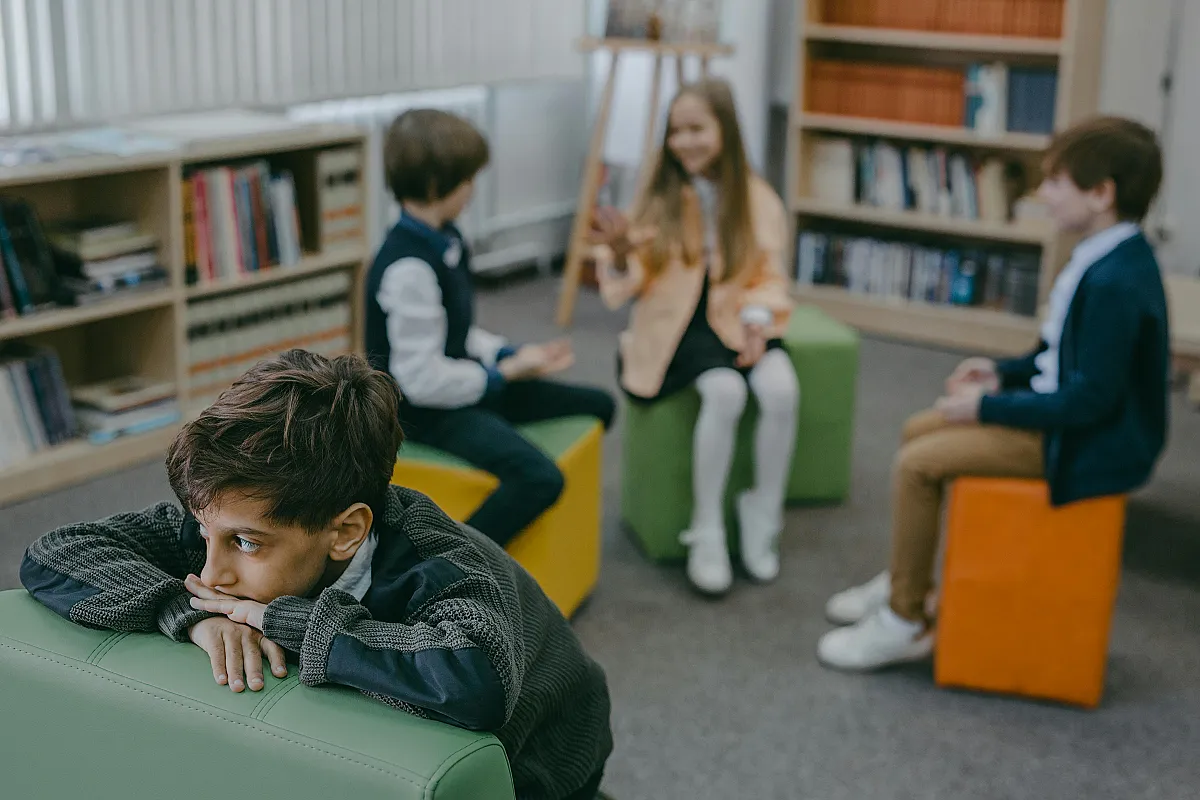
A child enters the classroom, greets almost silently and looks at everything around him. Then timidly sits on the edge of the chair and hardly moves. The lesson begins, but the child still tries to be invisible. He is afraid that something bad will happen. He feels helpless, vulnerable, he is afraid to participate in new games, answer lessons, go to the board. Such a child is distinguished by great anxiety. Often the experience before the event is stronger than in its moment.
This condition can be associated with low self-esteem and excessive demands on yourself. The child considers himself worse than others in all respects: externally, intellectually, physically, so he tries to be invisible in the classroom.
How to distinguish anxiety from anxiety
Anxiety is a temporary disturbance. Anxiety, on the contrary, is a permanent condition of the child. For example, a child is worried before a holiday, where he has to go on stage and tell a poem. And after everything passes, his nervous system returns to normal.
If this condition is observed in a child often, for example, when communicating with other adults, children, when answering at the board, then, most likely, this is chronic anxiety.
What is a dangerous anxiety state
Anxious children are more susceptible to somatic problems, which are expressed in dizziness, abdominal pain, spasms in the throat and coughing attacks. In an anxious state, the child may dry out sharply in the mouth, heart rate and weakness in the legs may occur, which is very similar to a pre-fainting state.
If a student regularly has a high level of anxiety, then this negatively affects not only his health, but also the psyche. He loses motivation to study, begins to slide into all subjects, symptoms of neurosis appear.
A high level of anxiety prevents the child from communicating with peers and making new acquaintances. Often these guys are closed and have no friends.
We can say that anxiety has a bad effect on absolutely all areas of a child’s life. Therefore, it is important for parents and teachers to learn how to help cope with it, as well as try not to become the cause of its development.
Why does anxiety arise and increase in school?
The most difficult periods in the life of a child are those when his life changes dramatically. From the age of 7, children go to school, they are entrusted with the responsibility to study well, follow school rules, try to be more successful than their peers.
Psychologists have identified common reasons why children in school often have anxiety:
- features of the nervous system of the child: he is hard to get used to the new, does not fit well with people, acutely feels anxiety;
- High demands at school that do not match the child’s abilities
- unhealthy emotional situation in the family;
- authoritarian teaching, when the teacher neglects the individual characteristics of children;
- indifferent attitude of the teacher to children;
- Contradictions in the family regarding the assessment of the child's activities: mother says one thing, father - another, grandmother - the third;
- Failure to adapt to kindergarten or school
- Change of class, school, moving to another country.
Summing up, if chaos reigns when raising a child, then the response to this confusion will be an increase in the level of anxiety.
How parents can reduce their child’s anxiety
The recommendations below will help to work out the emotional and physical state of the child, as well as teach him to independently manage his behavior:
- Talk more often, analyze feelings and emotions together, carefully take an interest in what is happening in the life of the child.
- Talk about your feelings and emotions. Share what you feared as a child and how you dealt with it.
- Notice and share your child’s success with all family members. This will help him become more confident and calm.
- Avoid toxic phrases that affect self-esteem.
- Be consistent in the education process.
- Hug more often. Hugs relieve emotional and muscle tension well.
- Teach the child to relax, as in an anxious state, the muscles are strongly pinched. For example, you can offer to fantasize and imagine some beautiful place: the sea or the forest in the summer, how warm and good it is, waves make noise, birds sing. Then share with each other the feelings of the presented. It is especially useful to do this practice before bedtime.
- Help, but do not do for the child. He should be able to get his life experience and learn to deal with different situations on his own.
What to do to reduce the level of anxiety in the classroom
- It is necessary to create situations of success in the classroom and celebrate the victories of each child. Find out what he does best and emphasize it.
- Structure lessons in such a way that each student is interested. For children in primary school, you need to use exercises in a playful form.
- Be consistent. Clearly and clearly formulate their requirements and monitor their implementation.
- Accept, respect, and love each student without looking at ability or achievement.
- Avoid frightening and negative phrases.
- Before testing, encourage and support children, assuring that you will be there and always help to direct thoughts in the right direction.
- Remember nonverbal communication. Watch the tone of voice, speech and gestures. Smile more and enjoy meeting students at the beginning of the lesson.
- And just love your profession and every child, because children are very sensitive.
Prevention of chronic anxiety in children
It is important to explain to your child that being nervous is normal. Sometimes there are problems and difficulties in life, but they can be solved and overcome. It is normal if in an incomprehensible situation he feels uncomfortable - this happens to everyone.
You should then train them to solve problems on their own. Below are 4 simple steps to do this:
1. Help us understand the situations in which anxiety occurs in school
This is necessary in order not to miss the moment when anxiety manifests itself and what happens. The experience gained can be easily transferred to other life situations.
2. “Exercise” alarm, pull it to the “light”
When anxiety occurs, you need to teach the child to “catch” it and give it a name. This technique creates a distance between it and anxiety. Making of the anxiety of the character, you can turn everything into a joke. For example, call it “Blot”, draw on paper, and then crumple the picture and throw it in the trash. Thus, the “blot” will be defeated.
With older children, another parallel can be drawn. For example, present anxiety as an unpleasant person who is not giving enough unsolicited advice. You can tell him, "Shut up! I will not listen to you. This will help you to switch and go about your business.
3. Teach your child to predict anxiety
When the mechanism of anxiety is already familiar to the child, you need not miss the moment of its occurrence and step back a step, thinking: “Aha, you again.” You showed up because I have a test tomorrow at school. But I know what to do with you.”
So that the child can independently resist anxiety, you can teach him to do this exercise: write on a piece of paper three emotions that anxiety carries him. For example: “I will fail the test”, “Parents will be angry”, “I will not go to university because of poor grades”. And next to write the opposite statements: “I will cope with the test”, “Parents will support me”, “I will find my calling in life, despite the grades”. This practice will help in the future to recognize anxiety in different cases and resist it.
4. Lose anxiety situations with your child in advance
It is important to teach your child to feel comfortable in an anxious situation. For example, you can tell him in advance, “You have a math test tomorrow.” I think your anxiety might come back. What will she tell you? What are you gonna say to her? Share it. Parents need to make it clear to the child that at this moment it is normal to worry that they will be there to help him cope with this condition.
That is, first the child prepares for an upcoming event that causes anxiety, then tries to play it in his head, and then draws conclusions about how it all turned out.
This process will take time. But then the child will be able to independently realize their feelings, manage their emotions and be persistent in any difficult life situations.

Leave a Comment