

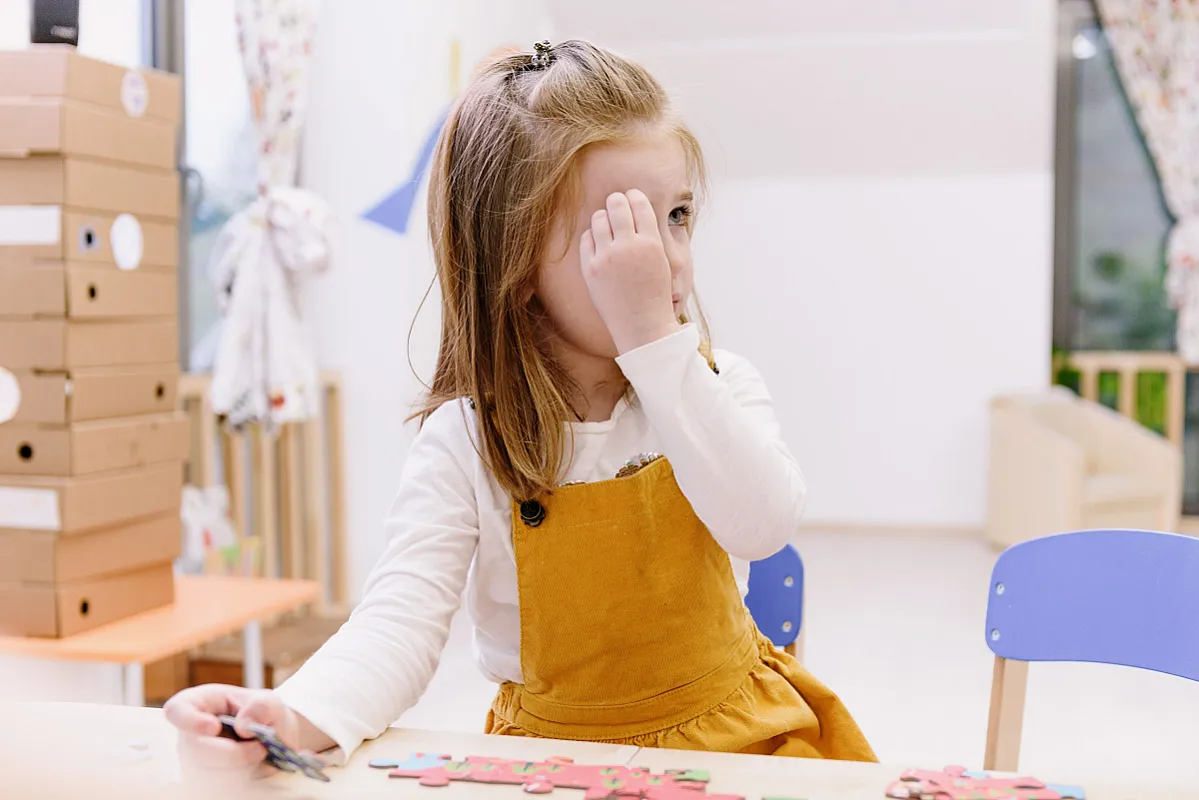
Why does this happen? If a child forgets everything, frequently loses things, and doesn’t remember requests, this indicates a lack of organization. Sometimes parents fail to instill helpful habits, do everything for the child, are overly protective and controlling, and don’t allow the child to be independent.
How can you help your child? You can work together to create a daily schedule, teach them to get ready for the next day in the evening, and help them develop the habit of checking their belongings. To make it easier to remember things, it’s helpful to use mnemonic techniques.
14 Reasons for a Child’s Forgetfulness
Sometimes parents start to worry when they notice that their child is constantly forgetting things. They might forget to bring a change of clothes, leave their pencil case behind, or not remember their homework at all. In reality, there can be many reasons for this forgetfulness—and not all of them are cause for alarm. Let’s figure out together why this happens.
No Clear Routine
If a child’s day is pure chaos—they get up, rush around, eat on the go, and forget their backpack—their memory simply can’t keep up with recording everything. Children remember things better when everything follows a familiar routine. For example, if a 7-year-old keeps forgetting things, they simply lack a system: what, when, and why.
Follow the same routine every day—and memory lapses will start to disappear on their own. This is especially true when a child forgets everything at school—missing assignments, forgetting their notebooks or a change of clothes—the reason is often simply a lack of routine.
Adults Do Everything for Them
When adults control everything—packing their backpack, telling them what to bring, what to wear, and where to go—the child has no reason to remember anything on their own. They get used to the fact that everyone always knows everything without them and lets their guard down. As a result, if no one reminded them, they simply didn’t do it. You need to give them a little responsibility at a time, even if the child makes mistakes at first. This is especially important if they’re always losing and forgetting things—without personal responsibility, they won’t start learning on their own.
Silent Protest
If a child is constantly being asked to do things—to study, to help out, to be “perfect”—he may start “forgetting” as a way to show that he’s tired. It’s like a silent protest: “I don’t want to try so hard anymore!”
They don’t throw tantrums; they simply stop doing things—and while it may seem like they’ve forgotten, they’re actually signaling: “This is hard for me.” In situations like this, it’s important to understand: perhaps the child isn’t “forgetting” by accident, but because they need rest and acceptance.
Stress and Yelling
If people at home often raise their voices, argue, or punish the child—the child lives in constant tension. And when anxiety and fear fill their mind, their memory doesn’t work well. It’s like an internet connection with a bad signal—it seems to be there, but then again, it doesn’t.
They aren’t forgetting on purpose—their brain is simply overwhelmed by stress. If a child forgets things quickly and seems inattentive, pay attention to the atmosphere at home: perhaps the reason isn’t laziness at all, but anxiety.
Too Much Going On Around Them
When there’s always a pile of toys, sounds, and people nearby, children can’t concentrate. For example, he was holding a shovel in the sandbox, saw another child’s excavator—and that was it; he forgot about his own. This isn’t absent-mindedness; it’s sensory overload. The less “noise” there is around them, the easier it is to remember things.
“Share” doesn’t mean “lose”
If you constantly say, “Don’t be greedy! Share!”—the child may start to feel as though their toys and other belongings aren’t really theirs. If they have to give everything away, why bother taking care of their things? As a result, they lose everything and don’t keep track of their belongings because they don’t feel they’re personally important to them.
Too Many Helpers
If there are several adults around at once—mom, dad, grandma, the nanny—and each one is giving advice, reminding them, or helping, the child has no chance to learn to do things on their own. They get lost in all these voices. And they don’t remember, because they’re used to someone else telling them what to do. And when they’re left alone, they don’t know what to do.
An abundance of things
When a child has too much of everything—toys, clothes, pencils—they stop appreciating it. Losing a marker isn’t a big deal—after all, there are 50 of them. And if everything is readily available, there’s no need to remember anything.
They don’t learn to be thrifty because there’s no shortage—there’s always a supply.
Memory doesn’t get used
Memory is like a muscle. If you don’t exercise it, it weakens. You need to include games that focus on attention and memory in his daily schedule. You should ask him riddles, teach him short poems, and have him list what happened yesterday. Without practice, memory “gets lazy,” and everything starts to be forgotten very quickly.
If it’s not interesting—I don’t know
When material is boring or hard to understand, the brain doesn’t want to remember it. It’s as if it’s saying, “Why do I need this?” That’s why it’s important to explain why it’s necessary and to present the information in an engaging way: multiplication tables as a game, and rules in the form of comics or songs.
Everyone around them is forgetful
If adults themselves can’t remember things, lose their keys, or can’t find their phone or notes—the child sees this and accepts it as normal. They think, “Well, if Mom forgets things all the time, then I can, too.”
We teach not with words, but by example. If you want your child to be organized, lead by example.
Got carried away—forgot
Children can “immerse” themselves in a game so deeply that everything else simply disappears. For example, a toddler is engrossed in building blocks and doesn’t hear you calling them at that moment. They aren’t ignoring you—they’re truly “in another world,” so to speak. This is normal; you just need to remind them ahead of time: “We’ll start getting ready in 10 minutes.”
Vitamin Deficiency
Sometimes a child is forgetful not because they’re inattentive, but because their body lacks essential nutrients. For example, a deficiency in B vitamins, iron, or magnesium can lead to reduced concentration, lethargy, and distractibility. If their diet is monotonous, it’s worth talking to a doctor.
Emotional Stress
If a child is going through a difficult period—such as a move, their parents’ divorce, or a conflict at school—all their attention is focused on their emotions. They simply don’t have the energy left for schoolwork or daily tasks. They may seem lazy or distracted, but inside, they’re going through a storm. It’s important to be supportive, talk things through, and give them time.
The main thing is not to panic. It’s better to calmly figure out why your child is behaving this way and gently start helping them become more focused. Everything can be worked out—with support, attention, and patience.
Tips for Parents of a Forgetful Child
First, it’s important to understand: is this absent-mindedness a well-established behavior or just a fluke that shouldn’t be taken as a problem? If an 8-year-old regularly forgets everything, then it’s definitely worth thinking about and gently correcting their habits.
Explain that every item isn’t just an object, but the result of the hard work and care of loved ones. A hat, a pencil case, a backpack—none of these things just appear out of thin air. Let them know that Mom and Dad work hard to make sure they have what they need.
If your child keeps forgetting things and is inattentive, try to bring a little more order and mindfulness into their daily routine. Small markers—personal symbols, stickers, or bright patches—will help them recognize their belongings more quickly and see them as “theirs.” This not only makes life easier but also strengthens their sense of responsibility.
Yelling doesn’t work in these situations. It only increases anxiety, especially in sensitive children. It’s better to talk calmly: let the child explain how it happened. Discussing mistakes together is far more helpful than scolding and lays the groundwork for developing independence.
When the question arises—why does the child keep forgetting things while studying?—the answer often lies in a lack of structure. Don’t rush to buy a new item if the old one is lost. Sometimes it’s helpful to wait a little while.
Feeling the inconvenience, the child will begin to exercise better self-control. This isn’t punishment—it’s guidance.
You can establish a household rule: “If you lose something important, you’ll have to do without it for a while or replace it with a simpler version.” This approach is pressure-free but has consequences. It teaches the child to appreciate what they have.
The skill of being organized isn’t innate; it develops over time. Show your child that everything has its place: a book on a shelf, shoes in a box, a toy in a drawer. Gradually, this will become a habit and help your child become more organized.
Before going for a walk or a trip, check your belongings together: “We have a ball, a water bottle, and a book—is everything here?” This way, the child learns to keep track of what they’re carrying and not leave things lying around.
A routine also plays a role. But it doesn’t have to be rigid. Take personality traits into account: some children get into the swing of things quickly, while others need more time to warm up. Planning helps eliminate the morning rush and reduce forgetfulness.
And finally, take a step back and look at the situation objectively: perhaps it’s not just about the child. When there are too many toys, clothes, and other items at home, the child simply stops paying attention to them. And this brings us back to the main point—a parent’s attention is more important than any gift.
The more care and involvement we give, the more the child learns to appreciate things. Developing attentiveness isn’t about control or pressure. It’s about working together, being patient, and taking a genuine interest in the child’s life. Let them grow up with a sense of confidence and an understanding of how to cherish what’s important to them.
12 Ways to Remember Information
These days, it can be hard for children to concentrate—the TV is on, a tablet is within reach, or toys are distracting them. And if you’ve noticed that your child keeps forgetting things—what you asked them to do, where they put their belongings—don’t worry. Let’s look at a few simple and effective ways to help improve memory and attention.
Clear Away All Distractions
To help your child focus, it’s important to remove anything that might distract them. Don’t try to get them to do their homework if the TV is on in another room or someone is talking loudly. It’s better to choose a quiet spot where nothing gets in the way—no bright toys, no gadgets turned on, and no noise. The quieter and cozier the environment, the easier it is for the brain to get to work.
Break everything down into small steps
It’s hard for kids to do several things at once. If you say, “Put away your toys, pack your backpack, memorize your poems, and brush your teeth,” they’ll only remember the first thing (at best). Instead, give them one task at a time. “First, put away your toys. Done? Great! Now pack your backpack.” It’s simpler, clearer, and less stressful.
Repeat with breaks
Don’t try to learn everything in an hour. It doesn’t work. It’s better to work on it little by little but come back to the topic several times. For example: learn a poem in the morning, again in the evening, and then the next day.
This is called spaced repetition, and it really helps “store” information in long-term memory.
Hang flashcards with important information around the house
This works if you need to learn new words, rules, or the multiplication table. Make colorful flashcards and hang them where your child spends a lot of time: on the fridge, in the bathroom, by the bed. They’ll catch a glimpse of them every day—and remember them easily, even if they didn’t plan to.
Turn information into rhymes and songs
If something is hard to remember, turn it into a rhyme. Even the most boring things, like Russian grammar rules, can be rhymed or sung. Children have an excellent musical memory—they pick up songs instantly and remember them for a long time.
Engage all the senses
Learning isn’t just about what you see. For example, you can:
- written on semolina with a finger;
- mold from modeling clay;
- arrange them with buttons.
When a child uses not only sight but also touch, hearing, and movement, the information is remembered much better. This is especially important for young children.
Review Before Bedtime
In the evening, before bedtime, simply talk to your child: “What did you learn today?” or “Let’s read that poem one more time.” The brain processes all new information while sleeping—and what’s said before bedtime is likely to “stick” in their mind for a long time.
Use colors
Children process information better when it’s bright and highlighted. Buy colored pens, markers, and stickers. The key is not to highlight everything, but only what’s important—such as keywords, dates, or formulas. This helps catch the eye and helps the brain remember.
Play
Memory isn’t developed just by studying from a textbook. Board games, puzzles, “Memory” games, and quests—all of these are great for training memory, attention, and thinking skills. And the best part is: kids think they’re just having fun, but in reality, they’re learning.
Practice Delaying Your Response
Ask a simple question and say, “Take your time; think about it for a couple of seconds.” This helps them avoid rushing their answer and teaches them to hold information in their minds.
Example:
— “What month is it now?” “Think… take your time…”
These little exercises are great for improving attention and self-control.
Teach them to take care of their belongings
If your child is always losing things, start with something simple: pack their backpack together every night. At first, remind them: “Check to see if you’ve packed everything.” Eventually, they’ll start keeping track of it on their own. This helps develop not only their memory but also their sense of responsibility. And when they notice on their own that they’ve forgotten something—be sure to praise them for being observant.
Feed them right
Diet directly affects memory and attention—especially during childhood, when the brain is developing. Add the following to their diet:
- fatty fish (salmon, mackerel);
- nuts;
- berries;
- leafy greens;
- eggs.
It’s not a magic pill, but your brain will thank you for this support.
Try different things, play, and involve your child—not in a forced way, but as part of everyday life. With a little patience and imagination, you’ll definitely see how much easier it becomes for them to remember things and pay attention.
Frequently Asked Questions About a Child’s Forgetfulness
And remember: children look up to us. If you don’t lose things yourself, plan your day, and keep a to-do list—your child will learn from your example.
What should you do if your child seems to be forgetting things on purpose?
Sometimes children really can “forget” something on purpose. For example, they might have left their diary at school—perhaps they’re afraid to show a bad grade. Or they might have “forgotten” their notebook to avoid doing homework.
If you notice that this forgetfulness keeps happening in the same situations, have a calm talk with your child. No yelling or scolding. Just ask, “Did you really forget, or were you trying to hide something?” Children often worry and don’t know how to talk about the problem. Your job is to be there for them and show that you can solve everything together.
How should you buy things if your child keeps losing them?
If your child is constantly leaving their pencil cases or hats behind, don’t rush to buy expensive or trendy items. Explain that every time something gets lost, it’s not only upsetting but also puts a strain on the family budget. For example, instead of an expensive superhero pencil case, buy a simple but practical one.
And if they have an allowance, you can agree that they’ll cover part of the cost of the lost item themselves. That way, they’ll start taking better care of their belongings.
When should you see a specialist?
If a child is simply absent-minded or forgetful, this can usually be corrected through good habits and attention. But if they’ve suddenly started forgetting everything, their grades have dropped, or they’re behaving strangely—it’s best not to wait and take them to see a doctor.
Here are some warning signs to watch for:
- A sudden decline in memory.
- Inability to handle routine tasks.
- Has become lethargic, aggressive, or withdrawn.
- Confusion with their surroundings (for example, unable to find their classroom).
- Frequently complains of headaches or has trouble sleeping.
If you notice anything like this—don’t panic, but it’s better to be safe than sorry; consult a specialist.


Leave a Comment