

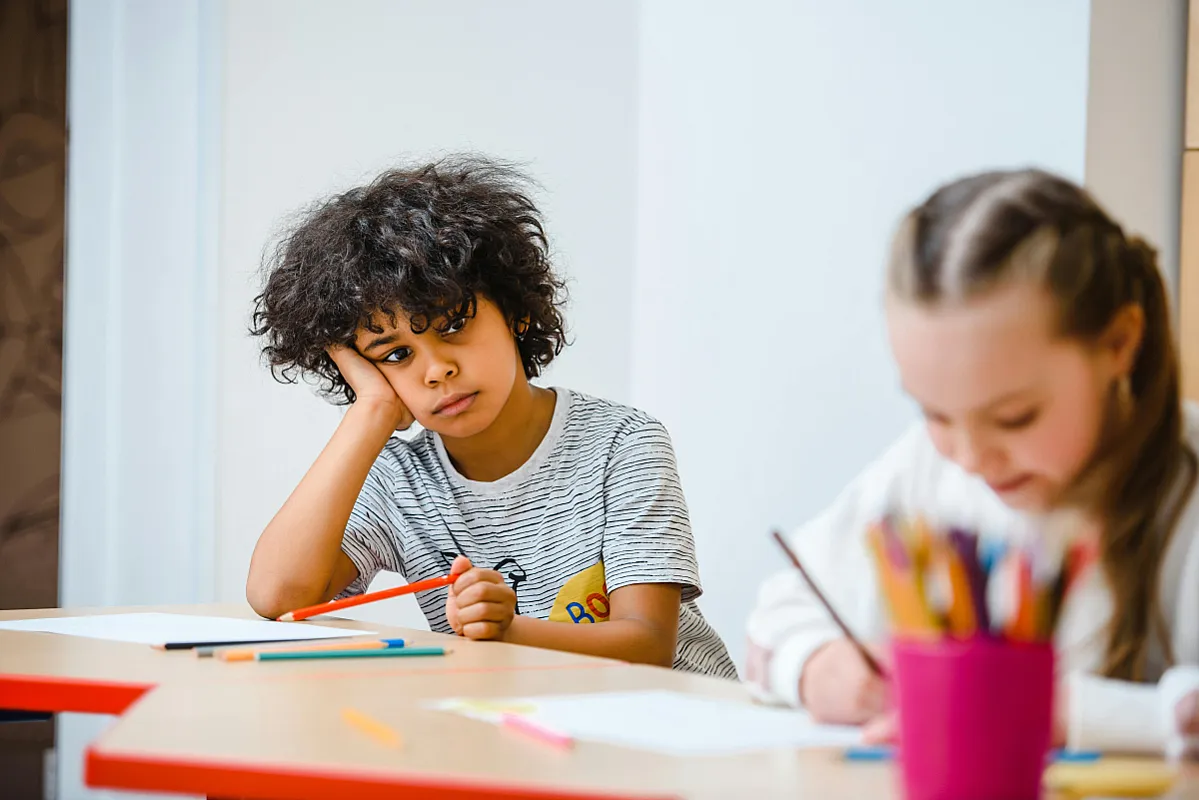
Does your child not want to go to school? Does she wake up in the morning and have trouble? In this article, we will talk about how to interest a child in school and save him and himself nerves.
Why it is important to engage a child in school
Today, the most acute problem of pedagogy is the almost complete reluctance of children to make efforts to gain new knowledge. For some students, the motivation to study disappears with time, and for others it is absent initially, so attending school turns into a daily hard labor.
What should parents do in both cases?
Coercion is not the answer. Over time, the child will begin to cheat and cheat, which will only aggravate the situation and negatively affect relations in the family. In addition, the child may permanently have aversion to learning. And this is much worse, because in the modern world you need to constantly evolve to be in demand.
The most effective way to engage a child with learning is the right motivation, which is associated with his personal desires and interests. For example, when a student is engaged in mathematics not because you need to get a good grade, but because he is sincerely interested in it and the process itself gives pleasure.
Let’s find out what types of motivation are available and which one works best for children.
Types of motivation
There are two main types of motivation – external and internal.
External stimuli are situations where we perform an action in order to get rewarded or avoid punishment. There are two subtypes: positive and negative motivation. For example, an external positive incentive is when a child is intensively engaged in the Russian language, because he wants to enter the journalism department. And external negative - when he behaves well, so as not to lose the long-awaited birthday gift.
Internal stimulus, on the contrary, is voluntary desire. As we mentioned above, the child does something because he wants to. An example of an internal positive stimulus - a child intensively studies mathematics, because he dreams of becoming a programmer in the future and creating his own computer games. And an example of negative motivation - he understands that with poor grades he will not be able to enter the university.
The best way out for a child who does not want to go to school is to have an intrinsic positive motivation. Therefore, in order to interest a student in learning, you need to fall in love with the educational process. This is quite simple if at school and at home adults adhere to the principles of humane pedagogy.
6 tips for parents if the child does not want to go to school
The essence of this problem is that if a child does not want something, it is not easy to force him to act against his will. You can repeat 100 times a day about the importance of studying in life, shouting, threatening, but this will not help to awaken his desire to take up textbooks.
1. Don't push, help.
Our psyche is designed so that when we are pressured, we resist with all our might. The more parents force a child to “church”, do homework, the more he avoids it. If a child asks for help with lessons, help, but do not rush, press or do for him. Stimulate responsibility by stepping back and showing that you trust him because he is smart and mature.
2. Give your child enough time to rest
Do you want a lot when you are tired, hungry or irritated? Also with the child and with school. Therefore, it is important to make sure that he sits full, rested and calm for his homework. Immediately after school, give him time to rest, and then start school.
3. Encourage curiosity
No matter how unhelpful and naive your child’s questions may seem, don’t avoid answers. Explain everything fully and with excitement, and then the child will form a habit of being interested in everything around, exploring and analyzing. He will learn to ask questions, think critically and learn new things at school with great pleasure.
4. Praise.
Praise your child for any academic success and interest in hobbies that are not part of the school curriculum. Criticism can also be used, but it must be constructive. If he makes mistakes in his homework, say, "It's okay, you just haven't quite mastered the subject." Let's do it again.""
5. Don’t forbid you to sit on the Internet, but teach you how to get there.
Today, it is important to own information, so you do not need to forbid your child to sit on the Internet and use gadgets. On the contrary, it is necessary to teach him to use them correctly. For example, look for additional information that is not in textbooks or find a training course on a favorite subject and take it online.
6. Translating lessons into play
The most effective method of teaching preschoolers and younger schoolchildren is play. During the game, the student is actively involved in the learning process, is not afraid to make a mistake and does not experience nervous tension, because everything is easy and fun to fix. The information received in the lesson-game and supported by positive emotions is remembered better, and the child has interest and desire to learn.
Therefore, if your child does not want to study at school due to the fact that he, for example, is hard at math or Russian, transfer the study of these subjects to a game format. Right now, you don’t even have to leave the house.
Online classes in mathematics and Russian in a playful form for children from 4 years old
What not to do
The desire to learn is inherent in us by nature. New knowledge and skills help us adapt and survive. Therefore, a child from birth yearns to learn the world and will strive to do so in school, if adults do not mistakenly retract his desire.
So what can't we do?
You can not punish if the child does not want to go to school and brings poor grades in all subjects. You can not blackmail him with rewards, for example: “I will not take anywhere, I will not buy anything, I will not let you play on the tablet”, etc. Such methods of education do not work. This, on the contrary, further pushes away from learning.
You can't compare him to other children. If you do this constantly, then, on the contrary, it is highly demotivating and will not help to become interested in studying. Comparisons should only be made between past and present achievements. The child will learn to lie and get out, and instead of responsibility and determination, he will develop self-doubt.
You can't overload your child with school. Today, you should not put education in a classical school at the forefront. Because most often children who categorically do not want to go to school, with great pleasure engaged in clubs, sports sections and online courses. It is additional classes that help to reveal in each child the inner potential that is not manifested in an ordinary school.
Therefore, encourage creativity, sports, music. Leave more time for hobbies that truly capture the child. Discovering new and interesting, feeling the support of parents, the child will love to study at school and learn to prioritize the knowledge that will really be useful to him in life.

Leave a Comment