

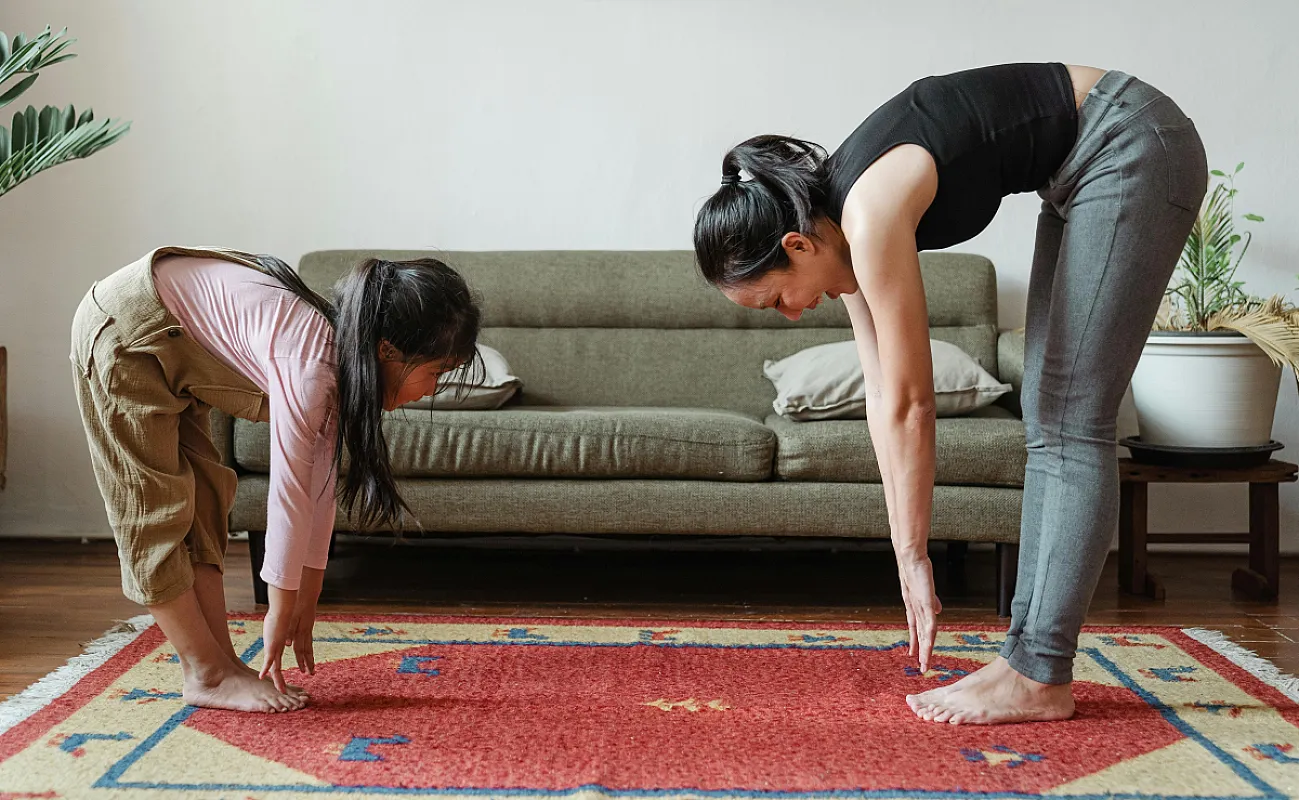
Incorrect posture in a child leads to violations of many body functions. In order not to face irreversible consequences, it is important to catch up and take action in time. In the article, we say on what grounds to determine a violation of posture in children and analyze exercises to avoid them.
One of the most common diseases of the musculoskeletal system is a violation of posture. This disease is observed in about 60% of modern children, and 15% of them already suffer from scoliosis in adolescence.
If you do not take measures in time, problems with the spine in the future are provided. As a result, breathing, blood circulation, digestive system work deteriorates, mental and physical performance decreases. Myopia and astigmatism may develop.
Look at your son or daughter right now. The norm is considered if the head is straight, the shoulders are at the same level, the chest is deployed, the legs in the knee and hip joints are straightened, the stomach is tightened.
Violations can be indicated by constantly lowered shoulders and head, an increase in the chest and cervical curves of the spine, a dangling stomach and a sunken chest. Next, you will find a test that will help to more accurately identify problems. Let's talk about avoiding them.
Prevention of posture disorders in children
The physical formation of a person is influenced by the environment. It is important for adults to monitor the position of the child’s body in a sitting and standing position, when walking.
Also, moms and dads should not neglect the following tips:
- Balanced nutrition
The daily menu of the child should consist of fresh fruits, vegetables, dairy products, meat, fish, so that the necessary vitamins, minerals and trace elements come with food.
- Games, walks, classes in the fresh air
They are useful for the normal functioning of the cardiovascular system, muscle strengthening, metabolism and good mood.
- Properly selected furniture for growth
The height of the table should be at the level of the elbow of the child in a standing position, and the chair should not exceed the level of the hamstring. When sitting, the legs should form a right angle. If necessary, you can use the stand under the feet.
- Lighting in the study room
When organizing the workplace of a student, follow the following rules:
Place the light sources so that they are on the opposite side of the hand with which the child writes;
combine the general light in the room with a table lamp;
- the colour temperature of the lamps shall be close to daylight;
Choose bright and cold upper lamps, but not pressing on the eyes.
- Sleeping place and position
The bed should not be soft. So that the body has support, and the muscles do not weaken and do not stretch, choose an orthopedic mattress. Sleeping is more useful not on the side, curled up, but on the back.
- The ability to sit properly, walk
The back should touch the back of the chair closely, but keep the bend of the lower back, the head should have a slight inclination forward, the chest should be from the table at a distance of up to 2 cm.
Starting from the age of 3, in the morning gymnastics of the child include exercises for posture, which we will consider further. Now we're offering a test.
How to quickly understand that the child has a problem with posture?
Put him in a relaxed position. Take a centimeter, and measure the distance from the protruding (seventh) cervical vertebra to each shoulder blade in turn. If all is well, the numbers will be the same.
The second way to check is to place the child with his back against the wall, where there is no plinth. His heels, calves, buttocks, shoulder blades and back of the head should touch it. In the lumbar and cervical region, the distance between the body and the wall should be approximately 3 cm wide.
Exercises for proper posture in children
In order for the child to develop a habit of properly sitting, standing, lying down, include the following classes in the daily warm-up:
1. The mirror.
Better to do it together, it will be even more fun. Slouch first, then straighten out. Look at your reflection and perform 10 to 15 times. Thus, a muscle feeling and a habit of correct posture are developed.
2. The wall.
Ask the child to stand against the wall (as in the test), and then, without moving the body, take turns to take the right and left hand to the side, climb on socks, sit down. It is recommended to fix each position in the static up to 6 seconds, to arrange a respite after the approach of 10-12 seconds.
3. Keeping objects on your head
Take a small pillow, a cube, a book. Put the child on the head (closer to the parietal part). Ask to move so that the object does not fall. Thanks to the exercise, a reflex of the correct position of the head is developed, the skill of controlling individual muscle groups is trained.
4. Motion coordination and balance
In the game format, you can make a stand on one leg or a “swallow”, sitting on a chair with a cube on your head, turn in different directions, walk on a log.
Such gymnastics helps to strengthen the muscles of the back and neck, develops a feeling of the correct posture, accustoms the child to the correct posture.
Also, in order to prevent posture disorders in children, it is important to prevent the development of flatfoot. The wrong position of the foot leads to negative changes in the spine.
It is important to understand that the described exercises are effective only up to 14-15 years. At an older age, posture is already formed and cannot be corrected by these methods.
Let your child be healthy and learn with pleasure!

Leave a Comment