

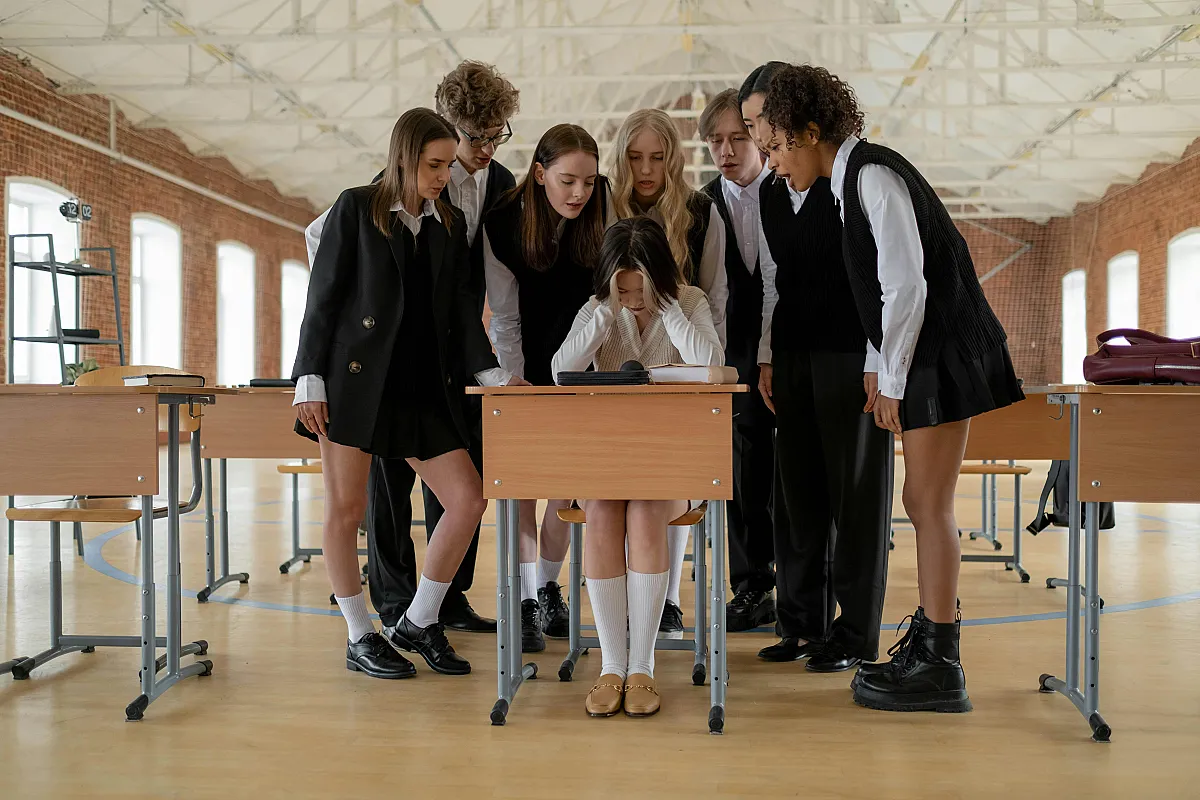
Bullying is the aggression of some children against others, bullying, harassment and pressure on the victim within a closed social group. Unfortunately, this is the most common problem in children's groups. It is most common in primary and secondary school.
It is important to distinguish bullying from conventional conflict.
Conflict is a one-time, short-lived phenomenon that occurs between equal participants. While bullying is peculiar:
- Intentional – the aggressor knows what he is doing.
- regularity – bullying is long-term, repeated from time to time;
- the mandatory inequality of forces of the participants – the victim is always much weaker than the aggressor;
- Sustainable roles - the victim is clearly chosen, and it always remains so.
As soon as a victim is “assigned” in the collective, we can talk about group violence. It is this group violence that traumatizes all participants.
Bullying participants
Everyone suffers in a bullying situation.
- Buller – from personal problems that caused aggression, from the destructive experience of impunity and the illusion of their strength, which in the future leads to antisocial personality traits.
- Victim – from discrimination and violence, experiences of humiliation, rejection and insecurity.
- Observers – from the “trauma of the observer”, the experience of powerlessness before the power of the crowd and shame for their weakness.
Observers
These are followers of the aggressor, silent witnesses, and potential defenders of the victim. This is the largest group in which everyone gets their own psychological trauma.
We're talking about kids. They don’t have the life experience to deal with such a situation. Not everyone can bear the sight of long-lasting violence. Children are often unable to accept or resolve a situation, suffering from their own helplessness and betrayal of their values. And unlike the victim, they can't scream from powerlessness or ask for help.
In addition, each observer experiences a strong subconscious fear of being in the place of the victim. It’s a very bad experience to see a member of your team abused day by day and no one, including adults, helps them. The child remembers this situation as possible and intractable, and will carry this fear with him for life.
Buller and victim
The bully is the one who leads the bullying. Most often they are children who are subjected to domestic violence or who have experienced traumatic moments in the past. Often, instigators have narcissistic traits, it is important for them to feel superior.
Victims often become children sensitive, emotional, with little social support, stand out, with features of appearance or development, different nationality. But just as often about cases of bullying tell beautiful, intelligent and talented children. Not "white crows." Or they are completely ordinary – not at all distinguished. It turns out that any child can become a victim.
An important fact, which we will repeat more than once, is that bullying does not happen because the victim is “not like that.” Bullying is not an individual problem, it is a collective problem.
If, for some reason, the victim falls out of the chain, such as moving to another country, another child is most likely to take her place within a few weeks.
If bullying is possible in the group, all children are restless and stressed. Stress is not a very useful condition for a child. It takes too much energy. It's bad for development, it's a smaller resource for learning, etc.
Now we will tell you what to do if you are faced with the problem of bullying, how to help the child and whether it is possible to prevent the team, so as not to face this phenomenon at all. But before answering all these questions, it is important to understand why there is a request for bullying at all.
Why is there bullying?
Pre-adolescent children have a need to be in a pack, to oppose themselves to others, to feel belonging. The vast majority need a sense of group cohesion. Therefore, it is extremely important that the team has positive grounds for this unity. If the adult responsible for the team creates these foundations – the children are busy with something, they have a common goal, common interests – the children’s need for belonging is satisfied, positive life experience is created and there is no need for bullying.
If the adult does not “cultivate” the group, does not deal with it and does not explain the rules of existence in the team, if the children came, unlearned and separated, the need for group cohesion is not satisfied. There is a need, but there is no cohesion.
And sooner or later there is a discovery: you can rally against someone, to oppose him.
If a group appointed a scapegoat and turned violent, it will remain so. The children’s team cannot stop itself – children simply do not have enough life experience to live such a situation. If they are left to themselves, the matter can go far.
Adult mistakes
Sometimes before you know what to do, it is important to understand what not to do. We have already explained the cause of bullying. The solution to the problem will be based on this. But first we will tell you what actions will not only not correct the situation, but can even harm.
"It'll pass."
Waiting for it to go away can take a long time. Because in children before adolescence, it certainly will not pass. Older - there is a small chance in the presence of favorable conditions.
Until the age of 12, children have poorly formed concepts of morality – the brain is not yet ripe for this. Therefore, it is very important that adults set the right guidelines – it is at this age that children are ready to hear and accept them. But in a teenage group, this is much more difficult.
Excuse bullying and blame the victim
Explanations as to why in a particular group there was bullying can be very much. The need for age, the pressure of a closed system, the tendency of the individual to victimize (the tendency to become a victim) or aggressive. All this is very important and requires attention. But not when the bullying situation already takes place.
Even if the instigator is alpha three times, and the victim is a white crow three times, this is not a reason for persecution. The rights of every child to protection are the same. There is no excuse for bullying. If gang violence is already happening, we need to urgently address the problem, not look for the right and the guilty.
Most adults are tempted to blame the victim. Justify the situation with the words “these are children, what you want” or “look, he’s some kind of “not”, so others hurt him.” The easiest way that a parent or teacher can choose is to throw the problem on the child.
Become “that way” and you will immediately cease to be humiliated – a fundamentally false statement.
Saying “it’s your fault, just change”, the adult transfers to the child an unbearable responsibility – not only for the occurrence of bullying, but also for its cessation. The consequences of such words for the individual can be the most devastating.
A child who tells an adult about bullying is not a snitch. As practice shows, victims endure to the last and reveal the problem only when it becomes completely untenable. And in no case can you finish a child experiencing regular group violence with words - you are wrong (not beautiful enough, too smart, conflicting, gifted, non-standard and any other). Be right and everything will be fine.
No, it won't. Because the problem isn't the victim's identity. It's a collective.
Pressure on the pity of the instigators or threaten them
Trying to explain to the aggressors that the victim is bad, appealing to sympathy or threatening to kill the victim has exactly the opposite effect. This will not only not help, but also strengthen the bully in a position of strength, give a sense of control over the fate of the victim. The latest attempts at a treaty with the aggressors will only humiliate and reinforce its helplessness. This is especially true when it comes to boys.
What to do to a parent if the child is faced with bullying
1. Don't panic.
Calm down and set up a conversation with the child. Be careful, do not show irritation or fear. You must broadcast strength, and nervousness and excitement are a sign of weakness. Do not teach the child, do not need omniscience. Listen and ask more than you talk. Gather detailed information about participants and bullying events.
Be sure to assure that together you will solve this problem – the child is in dire need of confidence and a sense of security.
2. Talk to your child in a way that helps them.
Support your child and tell them that you are on their side. Be sure to tell him what bullying is, and explain that he is not guilty of anything, that anyone can become a victim.
Plan what to do, because the child knows the situation at school much better. Discuss where attacks often occur and how to avoid them. If there is no possibility of avoiding it, think about how you can make him be there with someone you know. Discuss next steps. Warn that you will go to school for a trial.
3. Prepare for your school visit.
Warn about your visit in advance. Do not appear in the classroom – bullying participants should not know that you are interfering.
Do not take your child with you, even if the teacher or principal asks. He should not hear the possible flow of “he is his fault” and “children, what to take from them.”
4. Contact the person responsible for the team
Since bullying is a collective problem, it is important to solve it with an adult who is responsible for this team. With a teacher, a class leader.
Another important question – what and how to say? It is important that things are called by their names.
No “He doesn’t get along with his classmates” or “You know, kids always tease each other” can not sound. If a child is regularly bullied, brought to tears, spoil things, tease, call names, beat - this is bullying. And the sooner the phenomenon is named, the sooner you get closer to a solution.
Unfortunately, teachers do not always know what to do in a bullying situation. The most common reactions are denial of the problem, acquittal of the aggressors, phrases like “It’s children, what you want” and attempts to blame the victim for the fact that she is guilty.
Imagine you come to work. Nobody says hello to you. You walk down the hall, behind the laughter. Come to the meeting - everyone is demonstratively sitting down. You start working - you find that the chair is smeared with something nasty, the documents are spoiled. Find your personal belongings in the corner of the toilet with dirty footprints. It happens every day. One day you break down and shout, after which you are immediately called by the authorities and scolded for unacceptable behavior. “You have to be able to get along with your colleagues!” you hear in the end.
Give me an example if necessary. But do not put pressure on the pity of the teacher. Ask, "What do you think?" How did you feel?” Explain specific cases of child abuse.
Make sure that the responsible adult who will solve this problem understands the situation and calls it unambiguously bullying. If this does not happen or he does not have enough authority to solve the problem, go to a social teacher, psychologist, head teacher. It doesn't work here for the director. If there is no result, go even higher. Prove your intention to solve the problem, force you to recognize the problem and look for an effective solution. After all, every new day at school, where bullying continues, new risks to the health and condition of children.
5. Find out how the teacher is going to solve the problem
If the problem is named, but the teacher does not know how to solve it (and this happens most often), do not blame him, but ask him to study the issue as soon as possible. Make sure that in the event of violence, your child can ask for help.
6. If necessary, contact your child with a psychologist.
If you feel that you are not doing it yourself. If your knowledge and actions are not enough. If you see that the child needs professional help, contact a specialist.
7. Don't try to talk to bully parents
It's ineffective. Some will protect their children. Others will be punished (the next one will be the victim). Third parents will blame you and your child.
8. Do not ask your child to flirt with bullies, try to pay off or make friends, and solve the problem with retaliatory violence.
There are two extremes of bad advice that adults can give: “Learn how to build relationships” and “Back up!” Both of these messages to the child's psyche are: "No one will protect you, not even hope." Do what you want.”
9. The best protection against bullying is self-confidence.
Talk to your child and pay attention to them. Help them find a place where they are comfortable and make friends. Take seriously what he cares about, do not devalue his emotions. Teach him to respect and demand respect for his feelings, to defend his opinion. Do not be too obedient and obedient. Help them to live more often success – in a state of victimhood, children often begin to perceive themselves in a negative way. Therefore, it is extremely important for them to have a positive experience, to see that in fact they can do a lot.
10. Bring it to the end.
Don’t stop at short-term improvement. Press the situation to the end, do not expect that with a lull the problem will gradually disappear by itself. It is important to eradicate it firmly and forever.
Advice to the teacher
1. Recognize the problem and show that bullying is unacceptable
It is a mistake to call the participants of bullying by roles and discuss them. Talk about bullying as a phenomenon, without names. Children often do not know what they are doing. They have in their heads “we tease him,” “we play like that,” or “we don’t like him.” Children need to learn from an adult that when they do that, it's called that, and it's unacceptable.
2. Define bullying as a group problem
Say, "our group is sick." If a person does not monitor the cleanliness of their hands, they can catch an infection. And if the group does not monitor the purity of the relationship, it can get violent. It's very sad, harmful and bad. Let's get some treatment together.
This approach removes the contrast between victims, aggressors and witnesses, all in the same boat. It's a common problem.
With older children, you can watch and discuss "Lord of the Flies" or (better) "Stuffed". With the little ones, "Despicable Duckling."
3. Turn on the moral.
It is important to bring children out of the “stealthy” excitement in a personal conscious position, to include moral assessment.
For example, children can be asked to rate their contribution to a class illness called bullying. 1 point is “I never participate in this”, 2 points – “I sometimes do it, but then regret it”, 3 points – “bullying, bullying and will poison, it’s great”. Then let everyone at the same time show on their fingers how many points they would put themselves.
If they are not teenagers, there will be no “threes” even among the most inveterate aggressors. The important thing here is not to try to catch them in a lie, but rather to say, “I am very glad!” None of you think poisoning is good. It will not be difficult to cure our class.” Thus, the moral evaluation of bullying does not become external, imposed on adults, it is given by children themselves.
Of course, if the group is already mired in violence, the confrontation could be tougher. Here you can try to appeal to the aggressor. For example, reminding children about the ugly duckling story and its end. The duckling became a beautiful swan, and the birds that poisoned him as a child remained evil chickens. And then invite everyone to find their role in this story.
4. Create positive rules of life in the community
Of course, this should be done by a reputable adult. You can’t ban children from previous ways of reaction and not give others. That doesn't work.
What do I do? It is enough to formulate the rules of life in a group with children. For example: “No one can find out the relationship with his fists.” They don't insult each other. Do not look calmly, if two fight, they are separated.” And so on.
There is a wonderful therapeutic technique – “signing a contract”. When new “rules” are written down on a large slate, they are then voted on and everyone subscribes, pledging to comply.
5. Support positive change
Learn the methods of uniting the team. Playing games is the most effective way to work with children. Find the strengths of each student – one sings best, another draws, the third scores the most beautiful goals, etc. Holidays, contests, hikes and expeditions – the more diverse and meaningful activities, the healthier the group
6. Bullying is easier to prevent than to treat
The easiest and most effective way to prevent bullying is for children to face the fact that an authoritative person does not accept this position.
Simply put, if there is a teacher whom children respect, to whom they reach and want to like, and if this teacher immediately conveys the position of unequivocal rejection of bullying, bullying will not happen.
It is impossible to fight bullying without naming it, seeking excuses and admitting the victim's guilt. There is only one solution – an authoritative adult should unequivocally say that bullying is not acceptable. Not at all. Not for any reason. No one.
Of course, it is good if an adult immediately works for the cohesion of the group. If you follow roles, mutual support, the habit of resolving conflicts with words – in such a team, harassment will not arise. And if it does, the group will eradicate it itself before adult intervention.
If you are faced with the phenomenon of bullying, it is important to go this way with children and help them find a way out.


Leave a Comment