

Today, there are many useful and fascinating methods for the development of mathematical thinking, which are designed for children of different ages. But mental arithmetic is increasingly of interest to parents. What benefits does this technique actually bring to the child and is it possible to do it at home?
What is mental arithmetic
This is an effective method of development of children, which helps to learn quickly and easily count in the mind (to add, subtract, multiply, divide). Let's take an example. Try, without using the calculator, to name the sum of the numbers 158, 376, 34, 85. It's not easy. And a child who knows mental arithmetic will do it effortlessly and quickly.
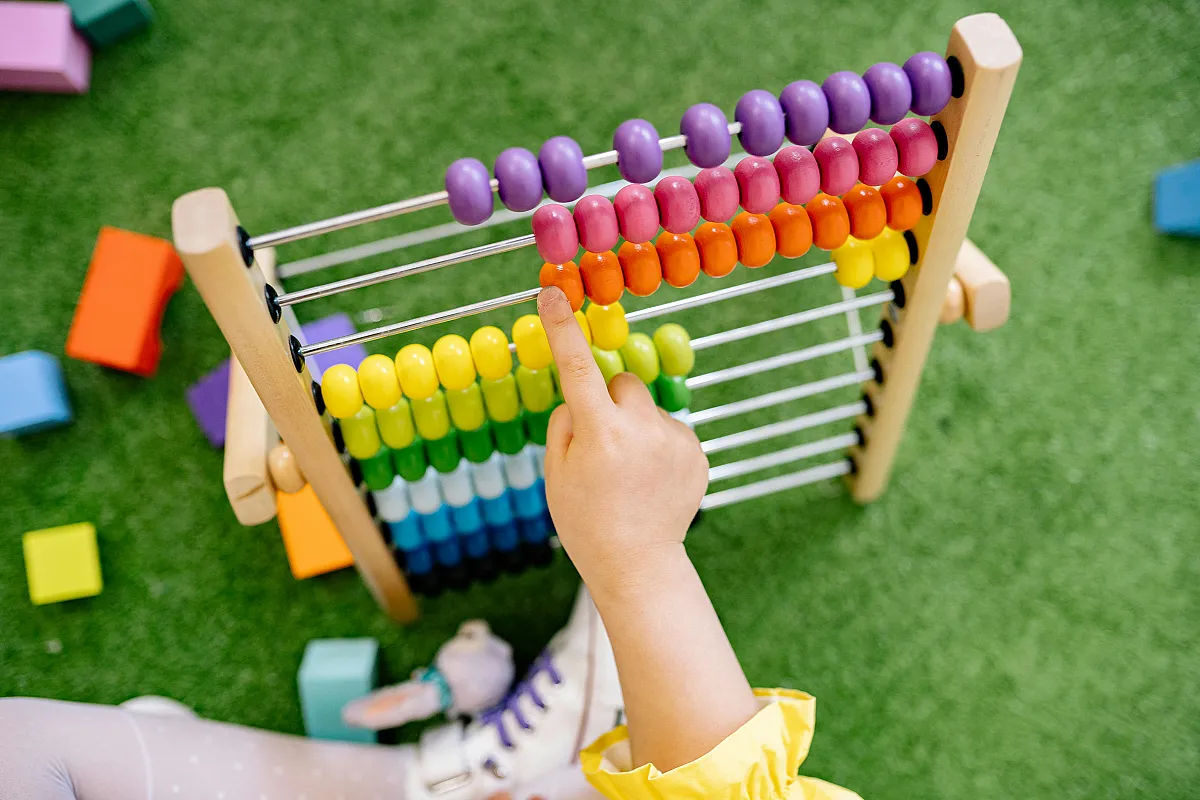
Training takes place on special accounts abacus (from the Latin abacus, "board"). Sometimes they use the Japanese name.spoiler?
It's very easy to use them. First, children type the first number, then on the right spokes - the second. Addition starts with a smaller number. If the number of knuckles on the spoke exceeds 9, then add a knuckle on the next one. Gradually, the calculation on the accounts begins to be reproduced in the mind.
What is useful mental arithmetic for children
According to Russian scientists in the field of neuroscience and psycholinguistics, mental arithmetic develops special cognitive abilities in children. There have been a lot of studies, the results of which made ambiguous conclusions about the benefits of the technique. Let's take a closer look.
Mathematical thinking is developing
Children quickly and accurately perform operations with 10-digit numbers in their minds. This helps to solve arithmetic problems more successfully, improve school performance, and impress others. These children are sometimes called “live calculators.”
Visual-spatial thinking is formed
Exercises on accounts improve the ability of orientation in space and perception of information by ear, thereby expanding the amount of short-term memory. This ability helps the child in school easier to cope with retelling, dictations, geometry and drawing.
Improved concentration of attention
It is this skill that modern children lack. Schools note that children can not keep their attention on one task for a long time, they are quickly distracted, which worsens the assimilation of information. Due to the constant concentration on calculations in the mind, a habit is formed to quickly concentrate at the right moment, not to miss the important.
There is an interest in learning
In the process of mental arithmetic, the brain of children works intensively, which does not let them get bored. Over time, the child begins to understand that when lessons are bright and interesting, learning becomes exciting. Homework turns into a continuation of cognitive games, not a boring routine.
Summarizing the benefits of mental arithmetic, we can say that it can contribute to the earlier development of logical, mathematical thinking in children, as well as those brain functions that would not be so developed without it. During classes, fine motor skills of the hands, left and right hemispheres are simultaneously involved. Thanks to this, emotional intelligence, perseverance and purposefulness develop from early childhood.
Popular myths and misconceptions about mental arithmetic
On the expanses of the network you can find many articles that mental arithmetic is not at all useful, and even harmful to children, that if you quit classes halfway, the result will not be. As a matter of fact, let's work it out together.
Mental arithmetic will prevent you from mastering the school curriculum
Many people believe that if learning happens differently and the child is interested in lessons, then he will simply get confused or bored at school. First, the purpose of mental arithmetic is to teach quick calculation in the mind. Secondly, having learned to count and having dealt with mathematics, the child changes his attitude to the previously unloved subject and feels more confident in school.
Another thing is that learning takes time, and in fact it takes a long time. To achieve success in the subject, you need to practice every day for 2 years. And that’s a lot of work for a kid who’s been given so much at school. Therefore, think in advance whether your child needs mental arithmetic or it is better to tighten up mathematics in individual classes with a teacher.
Mathematics will not be taught this way.
There's some truth here. A child won't learn division. You still have to learn the multiplication table. Multiplication in the accounts is quite complicated. To multiply by 3, you need to perform 3 difficult manipulations. But, believe me, in them the child will get confused faster than in 2-3 days will remember the entire multiplication table.
In addition, such difficult classes can be absolutely not to the delight of a young student who is just taking the first steps on the way to knowledge.
You can't throw halfway.
It's true. If you stop learning, the child will have to learn to count again. Since the full account system can be mastered only at the end of the course. And for this, as we said, it will take at least 2 years.
You can start with almost zero knowledge of mathematics.
When enrolling in a course, they say that the basic skill that you need to start classes is the ability to count to 10. That's not exactly true. If the child is poorly oriented in numbers, then when calculating the accounts, he will certainly have errors. Such exercises will not bring the expected result. In this case, it is better to start with the basics and write it down for a basic course in mathematics.
Modern students already spend a lot of time on gadgets, why add more mental arithmetic online
We disagree with this assertion. A new generation of children is distinguished by digital thinking. Today's students no longer read, but watch and listen, consume information in an accelerated mode. And no one is surprised that children, being in the same class, it is easier to text a friend on the phone than just say. It's neither good nor bad. It's just modern realities. And the task of parents here is not to conflict, but to keep up with the times and teach their children through gadgets to develop abilities and expand the horizons of knowledge.
Besides, it's convenient. Today, to form mathematical thinking in preschoolers do not need to go anywhere. You can simply turn on the computer and study at home, getting quality knowledge in a comfortable environment.


Leave a Comment