

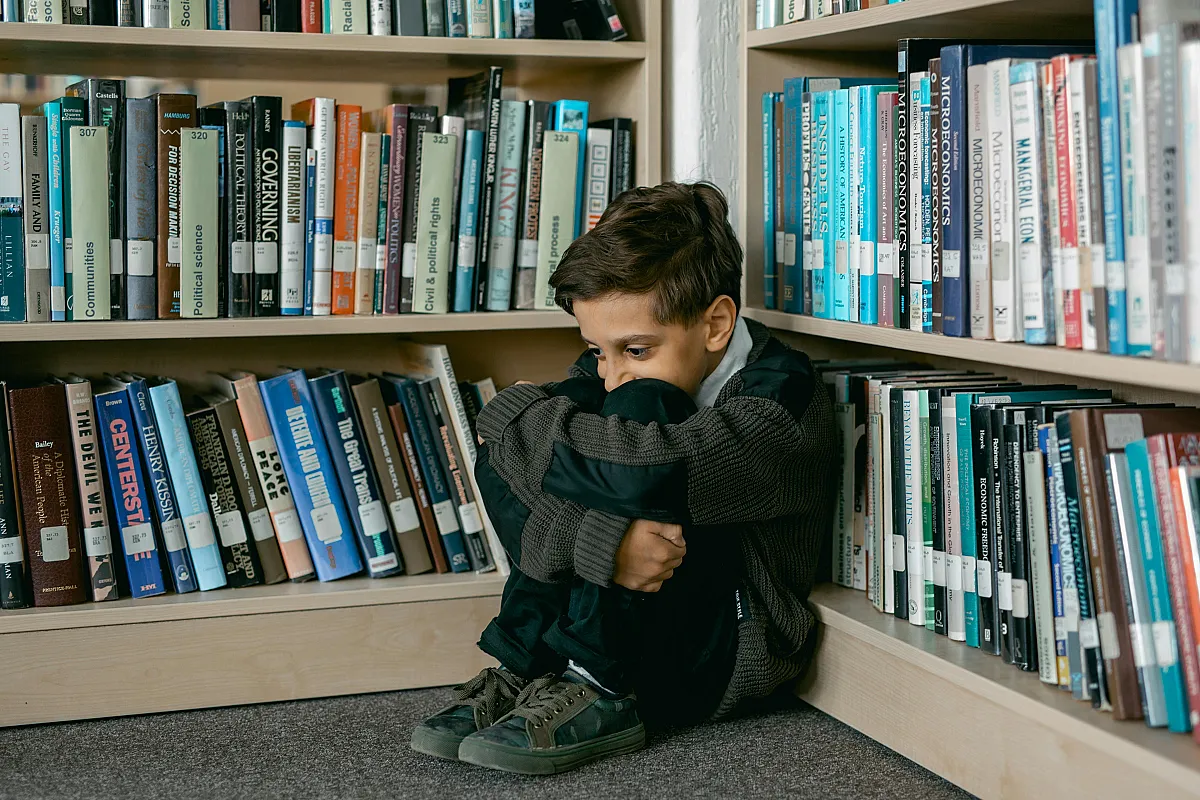
The child reluctantly sits down for lessons, walks in a depressed mood and tensely counts the days before the holidays. Don't rush to accuse him of laziness. There are typical signs of school maladjustment. Let us understand why such a phenomenon occurs and how to find a way out of this situation.
Disadjustment in school - recognize on time
Parents are unlikely to realize what difficult emotions their child experiences, crossing the threshold of class. For him, it is comparable to moving to another dimension. Here successes and failures, self-assertion and uncertainty, friendliness and, unfortunately, hostility are mixed. Quite serious challenges for the fragile child psyche. Therefore, it is not surprising if at some time there is a failure in the relationship between the student and the school. Psychologists use the term “disadaptation.”
What is the essence of the problem? If formulated in academic language, it would sound like “a violation of the process of adaptation of the student to the conditions of the school environment.” Well, in a simple way, it is difficult for a child for some reason to feel one with the school.
Not having the skills to analyze his condition, the “rebel” goes about emotions. He may be withdrawn or be defiant. There is a suspension from the educational process and social life of the class.
Three crisis periods are divided: the first year of schooling, the transition from primary school to secondary school and adolescent school maladaptation. Each age has its own characteristics. The task of parents, teachers, psychologists is to support and overcome difficulties with the least losses.
Signs.
To catch the symptoms of school maladjustment in time, adults should always be alert. In what mood the son or daughter returns from school, has the behavior changed dramatically? The answer to these questions is drawn in close attention and caring attitude to the life of the child.
The first warning sign is a decrease in academic performance. Do not sound the alarm at the first two. But if unsatisfactory grades began to appear systematically and from different subjects, this is already a reason for the SOS signal.
Early symptoms include fading interest in knowledge. The pile of unlearned homework begins to grow, as a result of which the test begins to cause fear, and the exit to the board is equated with a natural disaster.
The late stage is characterized by open ignorance of study, absenteeism and deliberate violation of discipline. In a conversation with a concerned teacher, the word "unmanageable" slips. Another variant of maladaptation is possible: apathy takes over the child. He becomes indifferent to hikes, sports competitions. The number of friends is decreasing, and live communication is increasingly in the background.
What could be the reasons
Experts have identified a number of factors of school maladjustment. In primary classes, they include psychological unpreparedness for the educational process. Yesterday's preschooler imagined school as a playground and is discouraged by his unusual duties. The baby can not adapt to the new mode of the day, he gets tired, and a beautiful picture of an exciting pastime begins to crumble.
Another reason is the lack of knowledge and skills. The teacher focuses on the average student, and children with lower intellectual baggage do not keep up with the pace of the curriculum. Especially difficult physically weak and slow guys.
High school students can “break” conflicts with peers or a teacher. It is important for teenagers to feel accepted in the team. Being rejected for them is a blow to self-esteem, from which it is difficult to recover alone.
What is dangerous school maladjustment
Negative emotions can cause irreparable harm to the individual. Disadaptation of the child in school threatens not only psychological, but also physical consequences. In children, sleep is disturbed, chronic diseases worsen. In more serious cases, clinical disorders are possible: tics, enuresis, asthenia.
Deformation is the driving force of learning – motivation. No incentive - no development of intellectual, creative and physical abilities. It is increasingly difficult to believe in your own strength and not to give up.
Trying to restore balance in the surrounding reality, the child's psyche can get serious injuries. At a minimum, it will be a syndrome of failure, which will inevitably affect all areas of life.
Correction methods
To resolve the differences between the inner requirements of the student and external events, the joint efforts of parents and teachers are necessary. Each case is different. And you need to start with a deep study of family relationships. This is often where the root of the problem grows.
The correct diagnosis of the psychophysical state of the child can only be carried out by a psychologist. Based on the results, the specialist will develop a plan and indicate the correct vector of action.
The work will be long and painstaking. You will have to close your eyes to bad grades and possible failures. Love and support of loved ones is what is needed for effective rehabilitation in the most difficult case.
Another option is possible - changing the format of training or introducing additional classes on "lame" subjects online. Why online? So the child can study at home, in a comfortable environment, one-on-one with the teacher or in a small group of children. Less stress, higher results.
Prevention of child maladjustment in school
You need to start preparing for school from kindergarten. It is the responsibility of parents to teach the child the rules of behavior, self-discipline and respect for others. These skills are a good basis for a comfortable stay in the school environment.
The best warning of maladaptation is a trusting relationship in the family circle. The child should not be afraid to share with older patients, ask uncomfortable questions. It is a way of trial and error, and it is better to enter into it fully armed.

Leave a Comment