

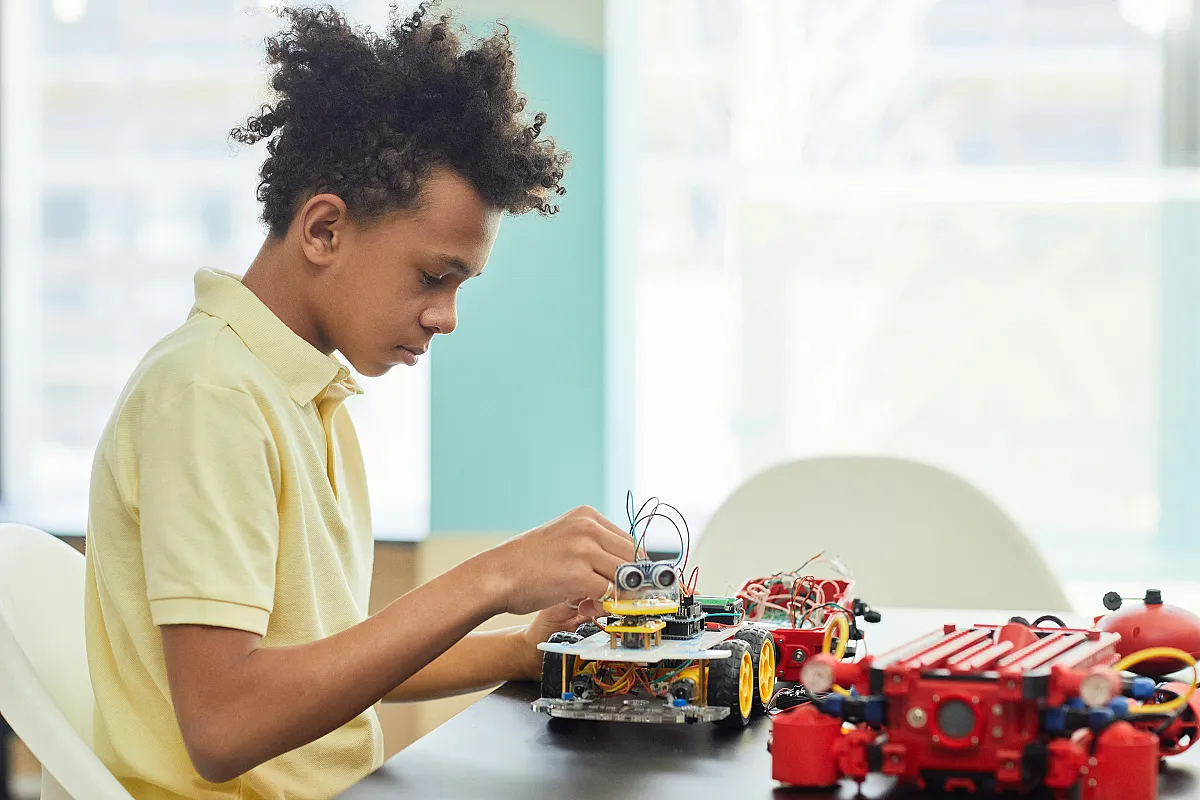
The article will introduce you to games that will help your child develop creative thinking, teach them to solve problems independently and overcome difficulties, and help them calmly perceive the imperfections of the world around them.
Theory of Inventive Problem Solving
The goal of the system for children is to develop imagination, allowing them to solve problems in unconventional ways.
For example, you can ask a child how to make sneakers closed without laces? Here are a few options: wrap them with tape along with the sole, sew hooks, buttons, or Velcro.
Today, of course, it's easy to imagine Velcro on sneakers, but it didn't exist until the 1980s. So this invention is someone's solution to eliminate inconveniences in various areas of life.
By the way, the TV also didn't have a remote control at one time. And one person came up with an unconventional solution.
Advantages of this system for children's development
For preschool and elementary school children, these are special games. They help develop the qualities of a creative personality in a child:
- broadens horizons, increases vocabulary, and fosters creative thinking;
- develops logic;
- improves memory, imagination, and visual-figurative thinking.
⠀
Children who study using this method become more open, sociable, learn to defend their point of view, and independently find a way out of difficult situations.
3 methods to help develop creative thinking in a child at home
To teach a child to think creatively, you can do without special classes. Try the methods described below.
Brainstorming method
Essence: participants actively discuss a problem. Each needs to come up with as many solution options as possible and talk about them. The main thing is not to nitpick or criticize hypotheses. This approach helps combine the efforts of several children and unleashes imagination.
How to use it?
- Gather the children in a circle. If there is only one child in the family, you can invite their friends over.
- Come up with a game or task.
- Ask the children to take turns sharing their ideas for solving it.
- Discuss the ideas together with the children.
- Decide which idea can be implemented.
Here's an example of how to solve problems using the brainstorming method.
Ask the children who can swim. Some will say they can, others that they cannot. Ask how to make the pool safe for those who cannot swim?
Give them time to think. If they can't come up with anything, help with leading questions.
For example:
What do you think prevents a person from drowning in water?
Let the children use their imagination and share their hypotheses, accept all answer options. Then go through each solution one by one and choose the simplest to implement.
Using the same scenario, you can analyze any familiar fairy tale and ask the children what would happen if the hero acted differently.
System operator method
The essence of the method is to find connections between objects that can later be transformed into a system.
Let's analyze the story of a butterfly and rain. A butterfly was born. It will live only one day. During this day, it really wants to fly and see the world. It's raining, and it can't fly in the rain. What should the butterfly do?
The child's task is to break down the situation into systems and subsystems and suggest solutions for the butterfly.
- Ask why the butterfly can't fly in the rain. Because if its wings get wet, it won't be able to fly.
- Why won't it be able to fly with wet wings? Break down what the butterfly consists of: wings, legs, body, antennae, eyes. What the wings themselves consist of.
- What surrounds the butterfly in the big world? For example: sky, earth, trees, flowers, people, etc.
- Ask the child how all this knowledge can be used so that the butterfly can fly and see the world?
Answers can vary:
⠀
- the butterfly can fly under people's umbrellas;
- fly above the clouds;
- fly on a plane and look at the world through the window, etc.
Be sure to try a similar game; you and your child will enjoy it.
Robinson method
The essence of the method is to find the most diverse ways to use an object.
Ask the child to imagine that they are on a deserted island. To survive, they need to get food. They have nothing with them except large laced boots. How can they use them to survive?
If the child initially finds it difficult to come up with answers, help with leading questions. Break down the boots into components: laces and the boot itself. Then ask how the laces can be used to get food? Tie them to a stick to make a bow, make a fishing rod, weave a net to catch fish, etc.
During the game, you can complicate the conditions, making the child's brain work more actively and look for new solution options.
Playing with your child, you will also train your brain and develop your imagination. Come up with games on any topics that interest your child. The main thing is to play often to see the effect. For example, every weekend. Then, from childhood, the child will grow up creative, and you will rejoice in their successes.


Leave a Comment