

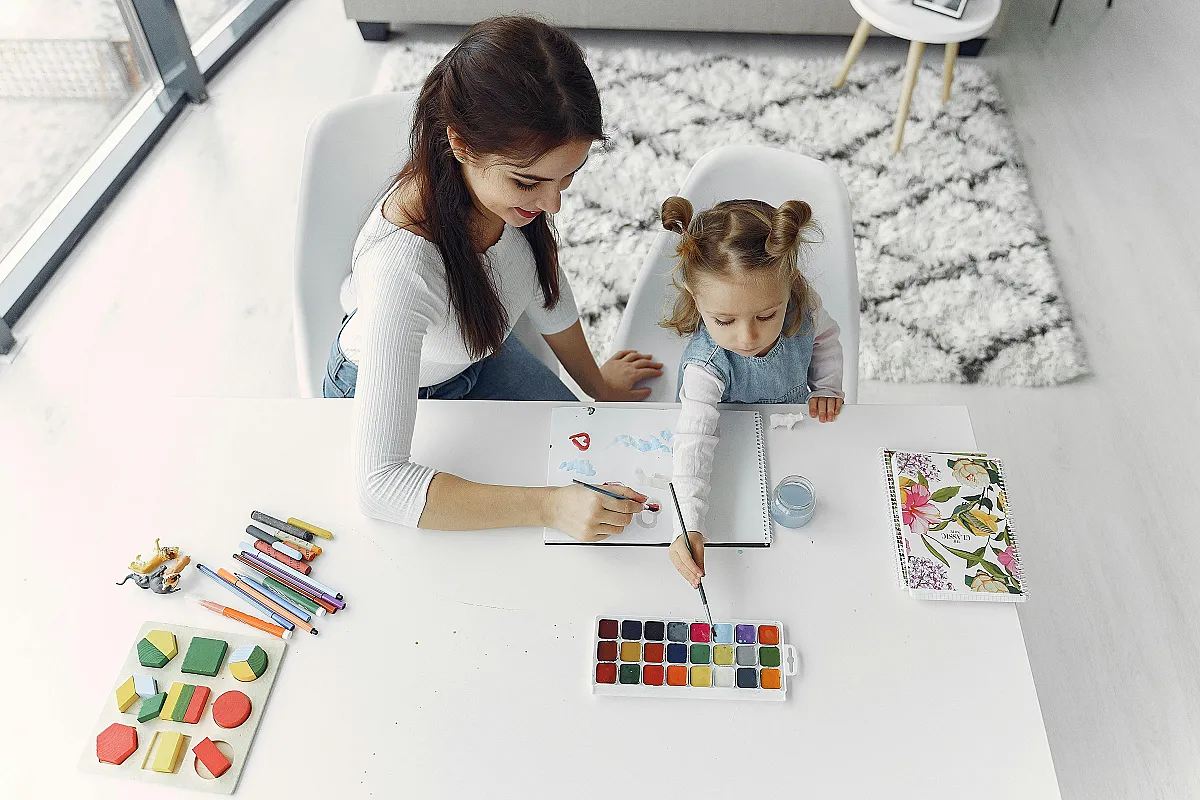
Do you have a favorite activity or hobby? How does it make you feel? Surely even the very anticipation of the upcoming activity immerses you in pleasant emotions and inspires. And then you feel like tension and stress go somewhere, there is pleasure and relaxation. Similarly, art therapy works for children. More about what it is and what benefits for the child, we say in this article.
What is art therapy?
Today it is quite popular direction in psychotherapy and psychology, which appeared a little less than a century ago. Initially, treatment was used only with fine arts, and later singing, music, dancing, sand therapy, modeling, etc. were added to the technique.
This type of correction of mental state helps to solve many problems and is considered the most gentle and environmentally friendly. The main goal of art therapy for children is the development of self-knowledge and self-expression abilities. We can say that through creativity, emotional intelligence is formed in a child.
A little history.
The term art therapy was coined in 1942 by British artist Adrian Hill. While battling tuberculosis, Adrian noticed that drawing helped him cope more quickly. He noted that during creativity, the mind is completely immersed in the process, so that it “disconnects” from its ailments. He then offered to try the art treatment to his roommates. Thus, a new direction in psychotherapy was born. In 1964, the first British Association of Art Therapists was founded.
Tasks of art therapy
Like other branches of psychological correction, art therapy is aimed at teaching a person to find ways out of life situations that cause him difficulties. For example, depression, phobias, which are accompanied by a lack of energy and loss of interest in life.
In the process of classes, thinking is rebooted and a person finds the very core that helps him develop a suitable behavior model and cope with his problem. As for children, art therapy works similarly. And along with the therapeutic effect, thinking and intelligence develop, creative potential is revealed.
Art therapy helps:
- relieve emotional tension;
- improve mood;
- learn to understand your feelings and emotions, as well as the emotions of others;
- Transform negative thoughts into positive ones;
- get rid of tightness and complexes;
- learn to express themselves;
- cope with age-related crises;
- See beauty in small things, develop creativity.
Art therapy in working with children also helps in the treatment of psychosomatic diseases, autism, cerebral palsy. Its use in combination with the main methods of treatment gives good results as an improvement in the condition of young patients.
Principles of art therapy
Diagnostics
As with any therapy, the psychologist must first understand what to work with and how to get the desired result. To do this, each specialist in the arsenal has special questionnaires, tests, role-playing games that will help to accurately identify the problem in the child and assess the degree of its depth.
Selection of method and type of art therapy
On the basis of diagnosis, the psychologist selects methods and types of treatment with art. Methods include:
- Active. The child creates an object of creativity independently from scratch. For example, draws a picture, sculpts a figure or composes a poem. The result of the work is not evaluated in terms of beauty and quality, the process itself is important.
- Passive. The child is offered to use ready-made works of art, for example, watch a video, listen to music, etc.
- Mixed-- The child creates his masterpieces on the basis of finished objects of art. For example, drawing or sculpting on a pattern.
Types of art therapy will be discussed further in the article.
Systematic work
Any method is useless if there is no clear system of action. Therefore, art therapy should also be taken seriously and regularly take your child to classes. For children 3 – 6 years old, 2 – 3 sessions per week are enough, for younger schoolchildren – 1 – 2 sessions, and for adolescents one session per week is enough.
Diagnosis during and after therapy. Evaluation of the result
To see if there is progress, the art therapist performs tests after a certain number of sessions and adjusts the methods and intensity of work with the child if necessary.
What types of art therapy are available
Today, among the types of creative therapy, you can choose the one that will appeal to your child:
- Isotherapy. This is the most commonly used form of art therapy. Here you can use various types of materials for creativity: paints, dough for modeling, plasticine, crayons, pencils, colored paper. You can draw on glass, water, lay out a picture of plasticine on paper or use bulk materials for this. You can also draw not with your hands, but, for example, with your fingers, toes, palms, creating your abstract paintings without rules and instructions.
- Painting in the sand. This type of therapy is especially liked by children. After all, it is so pleasant and interesting to drive your finger on the sand, creating your own drawing or invent and sculpt figurines from it. In the process of classes, the child develops fine motor skills, imagination, thinking and improves tactile sensations. You can register a child for special classes or make your own sandbox at home.
- Music therapy. The child can simply listen to music or participate in the performance of musical works: play instruments or sing in the choir. This type of therapy can be used by parents and children together to establish contact and improve relationships.
- Dance-motor therapy Here, movement to music is used to improve the emotional and physical state of the child. Have you noticed how your mood improves after a jog or gym? It is all about the hormone endorphin, which is produced in us during motor activity. As a result, the child not only improves mood, he also becomes more relaxed and sociable. This type of therapy can be used at home. Play your favorite music and dance together!
There is also drama therapy, when children play out any plots, biliotherapy - reading books and writing their own stories, puppet therapy - playing various situations with the help of puppet theater and adobe therapy - modeling from clay.
Art therapy for children
Summing up, I want to note that no matter what type of art therapy you choose for your child, remember that:
- The child should like what he does.
- He will be pleased to choose his own materials for creativity.
- During creative therapy, there should be no difficulties and tension, only pleasure and positive.
- The main thing is not the result, but the process itself.
Follow these simple recommendations, and your child will definitely take from art therapy all the positive that it can give.


Leave a Comment