

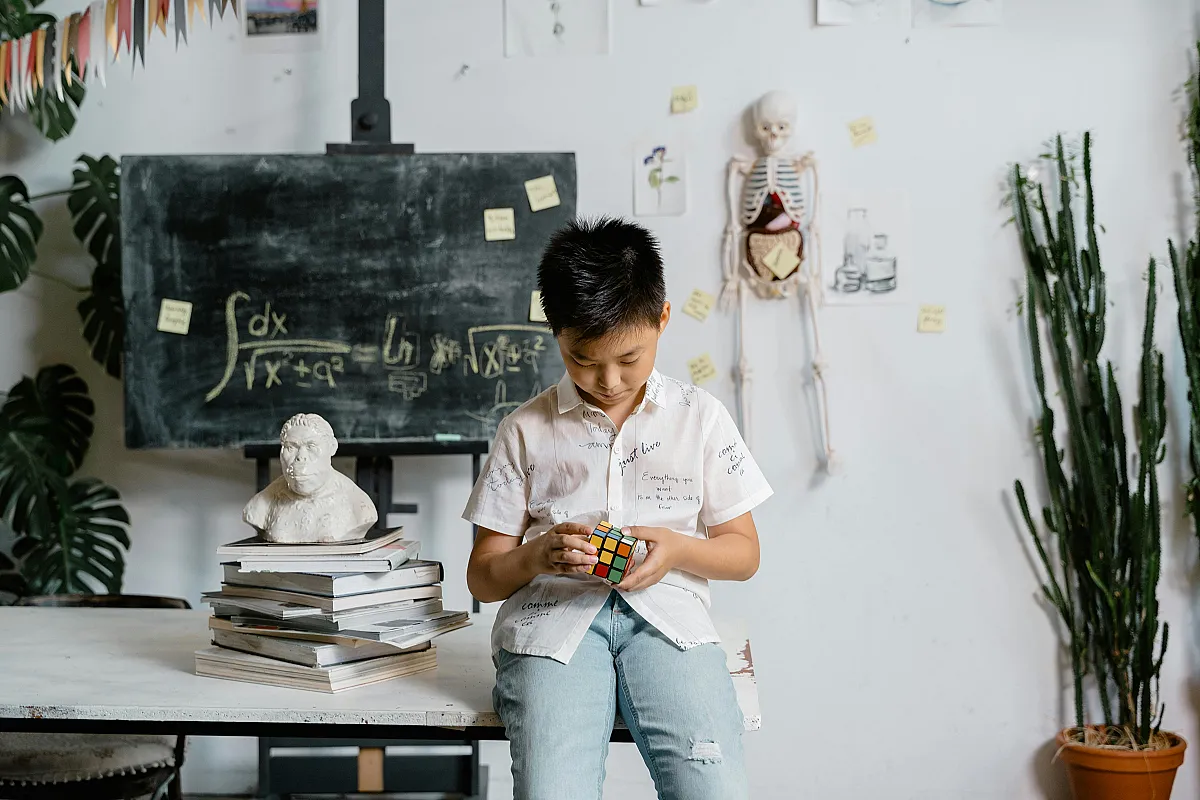
Why is learning easy for some children and hard for others? Is it about individual intellectual abilities? And yes and no. In many ways, success in learning depends on the ability of the child to focus on the lesson. Someone is collected by nature, and someone needs to learn attentiveness. In this article, we tell you how to overcome distraction of the child to improve school performance.
Attention is our ability to keep our focus on important things and tasks. If we didn’t have this ability, we wouldn’t be able to separate important information from secondary information and create chaos in our heads. Therefore, attention is a natural filter that does not allow you to go crazy and achieve your goals.
Characteristics of attention
To understand the reasons for the child’s inattention, you need to determine which aspects of it are well developed, and what you need to work on. Let’s look at what the attention consists of:
- Concentration - Ability to keep focus on the task for a certain time. The concentration of the child directly depends on this factor.
- Resilience – the ability not to be distracted by extraneous matters during the performance of tasks.
- Attention – This characteristic shows how many tasks a child can focus on at the same time. If the child’s attention span is well developed, the easier it is to analyze, structure and summarize information.
- Distribution and switchability – these qualities follow the volume and show how the child behaves in multitasking mode: is stressed or calmly switches attention from one thing to another, moving along steps to the goal.
How do you know if a child is scattered?
Below are questions that will help to conduct a simple home test for the level of distraction of the child:
- You have to repeat it several times before fulfilling the request.
- It only gets things done if you control it.
- He has difficulty sitting still and is often distracted.
- Fatigue quickly if you perform several tasks at the same time.
- When you do your homework, you make a lot of mistakes because you don’t get into it.
- He always forgets and loses everything.
Causes of Child Inattention
Individual characteristics
Several factors can be identified here:
1. Biorhythms
No wonder people are divided into “larks” and “owls”. For example, owls are more difficult to concentrate in the morning, and larks in the evening. It is worth watching at what time the child is more active and cheerful, and when it is better not to load it.
2. Immature areas of the brain
In the regulation of attention, several zones are involved: the corpus callosum, the thalamus, the middle brain, the hippocampus, the frontal lobes of the cortex and others, which mature unevenly. If a child has not developed enough parts of the brain to school, then attention will suffer.
3. ADHD
When a child is naturally very active and impulsive. Often, such children can not sit still and keep their attention on one activity for more than 5 minutes and differ in talkativeness, vertigo and mood swings.
4. Method of perception of information
Someone gives information easier to hear, someone perceives only visual presentation, and someone needs to write with his hand to remember something. According to the perception of information, Audials, visuals and kinesthetics are distinguished. Sometimes, the child should only change the way information is presented and everything becomes fine with attention.
5. Temperament type
There are 4 types of temperament: sanguine (movable and balanced), phlegmatic (inert and balanced), choleric (unbalanced), melancholic (weak type). We are born with a certain type of temperament, so in the early years of life it is very important to understand what type it is in order to properly organize the learning process in the future.
Physical condition
If the child is hungry, tired or sick, do not expect high concentration. It is better not to sit him down for lessons immediately after school, but to give him a break for a couple of hours. Because against the background of poor physical condition, mental abilities immediately decrease.
Lack of interest and motivation
If the child is not interested in class, he tries to entertain himself. And the best way out here is to make the classes interesting. In preschool and primary school age, the main activity of children is play. Therefore, to engage and retain the attention of students, lessons should be supplemented with elements of the game. And for older children and adolescents, motivation works well when they understand what they are studying for, what they are pursuing.
How to deal with child inattention
Children today find it harder to concentrate than previous generations. This is due to large amounts of information and clip thinking. To make it easier for a child to focus for a long time, you need to develop attention from childhood:
- Pay his attention to the little things. For example, what beautiful clouds in the sky, who or what they look like, how many centimeters a flower in a pot has grown over the summer, etc.
- Don’t spend a lot of time with gadgets.
- Bring variety to everyday life: walk in new places, come up with new joint hobbies and hobbies.
- Be an example. If parents demonstrate their concentration and attentiveness, the child will strive to imitate mom and dad, be no worse.
These simple actions will help the child to be more conscious and focused. And if you add to this special games and exercises, then there is every chance to overcome the distraction of the child in a short period of time.
Attention-building games
There are many exciting games that help in training attention. You can try different options and as the child grows older, complicate them. Below are examples of games that can be played anywhere and anytime.
Training of the gathering “Forbidden movements”
Ask your child to stand up straight and focus on your movements. Tell him what you will do with your hands, and he will have to repeat them. But there is a rule – hands should not be lowered down. If you put your hands down, the child should raise them up.
Training of attention distribution “counter”
The point is to count from 10 to 1 in reverse order and perform simple physical exercises at the same time.
The development of arbitrary attention "Draw"
Give your child a piece of paper and pencils. Ask him to draw in a row of 10 triangles and number them. Next, tell him to shade triangles 1.3.5.7 with red pencil in green, 4 and 6 in blue, 8.9,10 in red.
The development of active attention "Observer"
Ask your child to tell you where they are every day. For example, a schoolyard, a classroom, or the road to the grocery store. The child must describe in detail what he has seen hundreds of times.
If your child loves computer games, then you can look for something similar online.
The main thing, if you notice distraction in the child, do not leave the problem without a solution. It won't go away. Do not scold him for the fact that he constantly “counts crows”, but show love and respect, try to cope with inattention by joint efforts.
Try to spend more time together, make sure that his learning life was exciting and bright. Because the best motivation is the pleasure we get in any activity.

Leave a Comment