

How do I instill in my child a love and interest in mathematics until first grade? Teachers recommend using mathematical games for preschoolers. The child will not even notice that he is being taught, and you will see the first results after a month of regular classes. In the article you will find examples of what games to use to quickly develop critical thinking, observation, ingenuity and imagination in children.
How to start mathematical development in preschool games?
First, you need to teach the child to understand what quantity is and how to measure it, then proceed to familiarize yourself with figures and study the magnitude of objects. For each stage, we have prepared simple and exciting games.
Develop quantitative representations
Cat with kittens
You'll need: Toy set (you can take any animals, as long as there is a mother and children), cards from cardboard or flanelegraph.
How to play: Place a “mother with children” in front of your child and ask them to count the number of “children.” For example, the mother of a cat has 9 kittens.
Next, come up with a script and tell your child, “I’ll use circles to show a cat walking with kittens.” Your cats will walk the way I show them, and you will help the cat count the kittens and make sure no one gets lost.
Show with the help of circles options for the location of the cat with kittens and ask the child to repeat: top-down, right-to-left, around the cat, etc. In the game, you can also ask how many kittens the cat has, whether all the “kids” are in place, how many kittens are lost, etc.
This game develops the child's idea of the location in space and the conservation of quantity.
Acquaintance with numbers
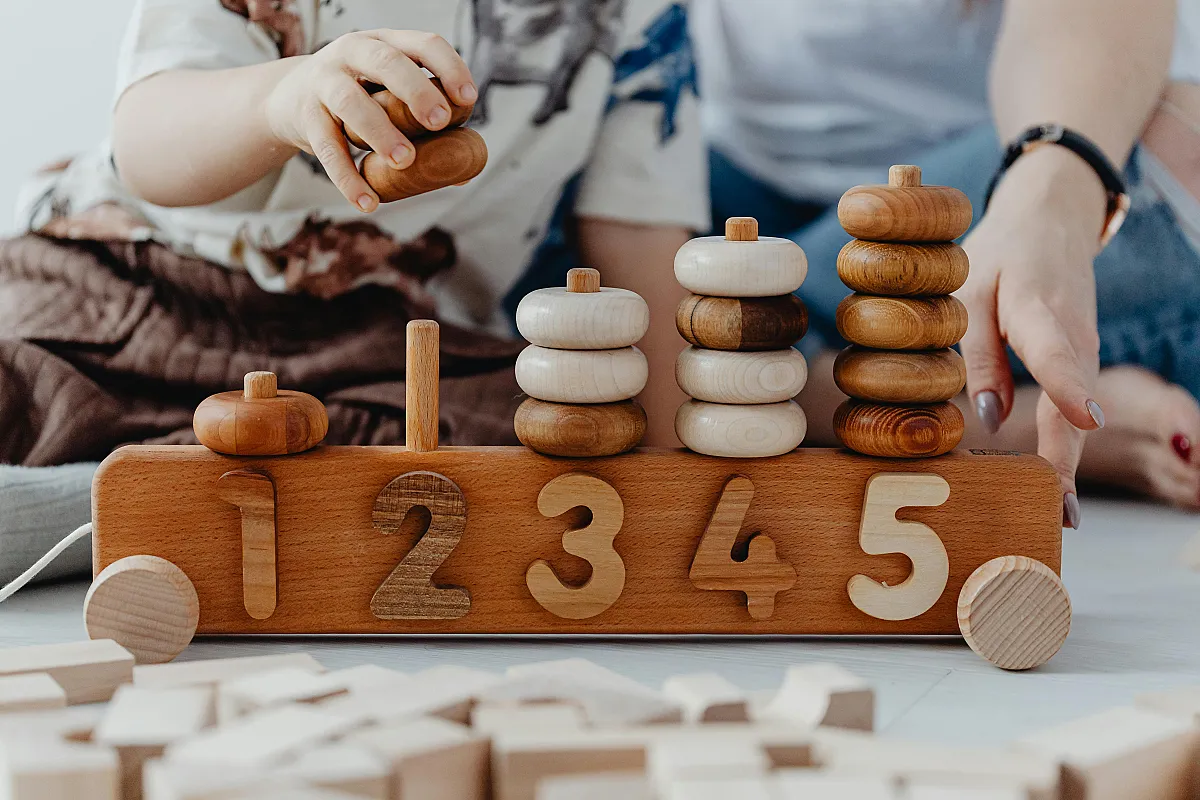
Cards with numbers (you can take plastic numbers on magnets) and any toys, objects that we will count.
How to play: Put the numbers in a box. We arrange toys in clusters in a row so that each pile has a number of items from 1 to 10. Ask your child to take a number or card out of the box, name it, and look for the right number of items.
If the child does not know the numbers, we help him. So you can simultaneously consolidate the skill of the account and acquaint it with the numbers.
What number was lost?
You will need: cards with numbers from 1 to 10.
How to play: The child arranges the cards in the right order and tries to remember them. Then closes the eyes, and the adult removes three or four cards from the row and mix them. The child needs to name the missing numbers, find and return them to their place.
If your child knows numbers up to 20, make it harder to use more cards in the game.
We study geometric shapes.
Find a figure pair
Cards with figures (if there are no cards, you can draw on separate sheets of paper yourself), any items, toys that will correspond to the figures.
How to play: We lay out cards with figures, say aloud the name of each of them (to begin with, you can use a square, circle, triangle). Find as many items as possible in the room for each figure. And to make it more fun, we invite a friend or friend of a child to visit and arrange competitions. Whoever finds more items wins.
Guess the figure.
You will need: cards with figures and good mood.
How to play: Put the cards with the figures face down. Pull out any card and try to describe the figure so that the child guesses it. Then we switch roles. This mathematical game is great for preschoolers 6-7 years old, helps to remember the characteristics of figures and develops imagination.
A treasure bag.
You will need an opaque bag or fabric bag. Small objects of different shapes.
How to play: Put in a bag of "treasure" so that the child does not see. We invite the child to take out the treasures in turn and to guess by touch what figure they resemble. To complicate the task, ask the child to find and get all objects square or triangular shape.
This game helps to remember and distinguish the geometric shape of objects.
We study the size of objects.
Set the route
You will need: a designer, two or three toys of different sizes.
How to play: Arrange toys. We ask the child to build two or three tracks from the constructor: short, long and medium. Tasks here can be different, for example: put the largest toy on the short track, the smallest - on the middle, and the medium - on the long track.
This game will help the child to include ingenuity and learn the concept of magnitude.
Magic basket
You'll need: Two baskets or two boxes, toy fruits, vegetables (or other toys, as long as they differ significantly in size).
How to play: We put baskets in front of the child, mix the fruits and ask him to spread them in different baskets. If you play in the company of a friend, you can arrange a speed competition. If you want to complicate the task, take three boxes and three types of items (large, medium, small).
The goal of the game is to teach the child to compare objects in size.
The two previous math games are good for preschoolers under 6 years old. And the next one will appeal to the older kids.
Say the opposite.
This game can be played on the road or in line. All you need is imagination and a good mood.
How to play: The adult says, and the child continues: “The bridge is wide, and the path ... (narrow)”, “The river is deep, puddle ... (small), “The window is wide and the door ... (narrow)”, “The coat is long, and the jacket ... (short)”, etc. Then you can switch roles and ask the child to come up with similar questions for an adult.
Mathematical didactic games for preschoolers with their own hands
Didactic games help to expand the horizons and ideas of children about the world around them. Mathematical development of preschoolers in games occurs softly and naturally, especially if these games are made with their own hands.
Count with your eyes closed.
How to play: Take a set of spoons of ten pieces. We ask the child to close his eyes and count the spoons to the touch.
To complicate the task, you can cut strips of the same length from cardboard and glue beads to them (on one - 1 piece, on the other - 2 pieces, etc.). The adult calls any number, and the child must with closed eyes find strips with the right number of beads.
Fun laces
For the game you will need 5-7 laces of different lengths and different colors. Putting laces on the table, ask the child how many laces he sees. Then we ask them to spread them in length from short to long, in width from thin to thick. You can also lay out geometric shapes from laces for example in the picture.
Complement the row
Cut the same strips from cardboard or plain paper. From colored paper cut geometric shapes. On each of the strips, stick figures and leave a place at the end so that the child can independently continue the row. The preschooler needs to continue the row, cutting or finishing the missing figures.
Mathematical games for preschoolers, we use any available materials, the main thing is that they are safe for the child.


Leave a Comment