

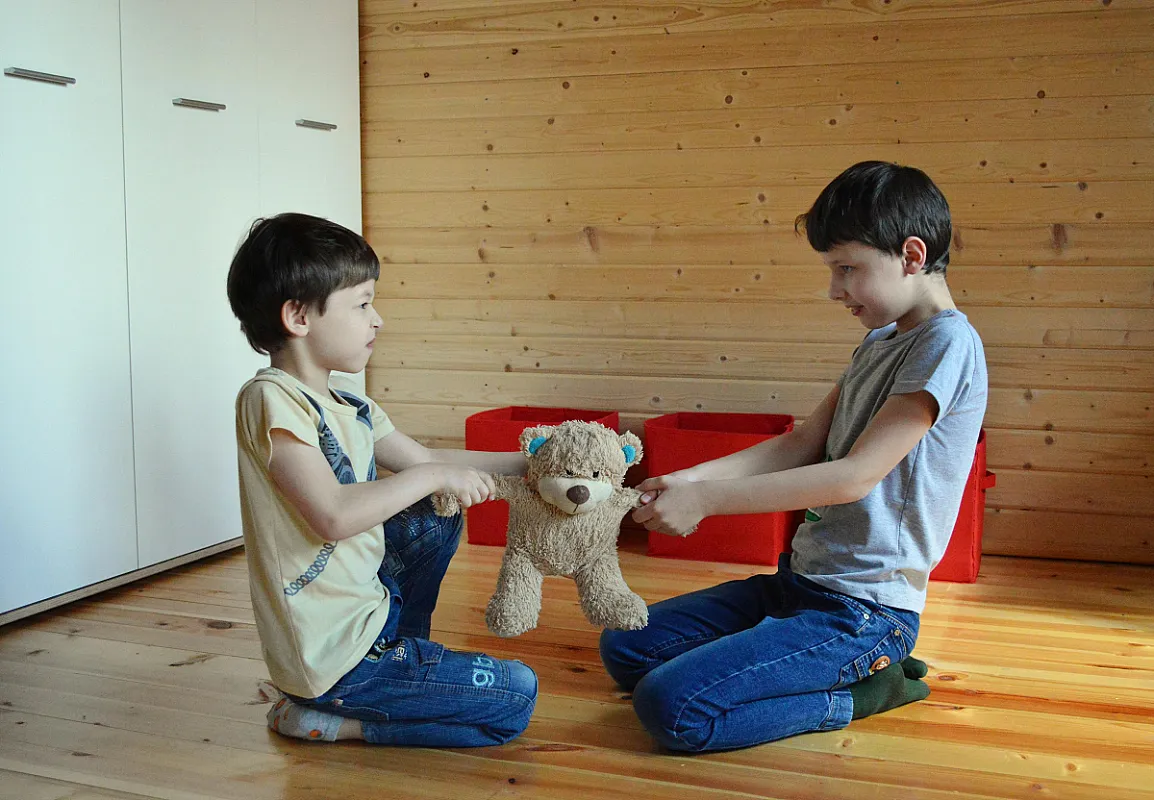
Conflict between children is a natural part of their development, especially at a young age. Parents often face a situation where children quarrel, swear or cannot find a common language. In such cases, the question arises: how to properly help children resolve the conflict without destroying their independence and without creating a false idea that it is necessary to reconcile only by order? In this article, we’ll show you how to teach children how to resolve conflicts constructively and why it’s important not to intervene too harshly.
Why do kids fight?
Before you begin to resolve a conflict, it is important to understand why it arose. Children's quarrels can have various causes:
- Competition for attention. Children often fight to get the attention of parents or other adults. This is especially true for young children who do not yet know how to express their emotions in words.
- Disagreement in games. A simple conflict can arise because children cannot agree on who will be in charge of the game or how to distribute toys. This often happens when children have not yet developed the skills of sharing and understanding the rules.
- Emotional response. Sometimes kids fight because they can’t control their emotions. They can’t always explain what’s bothering them and react to irritation or resentment with aggression.
- Personal boundaries. At the age of 3-4 years, children become aware of their personal boundaries, and conflicts can arise due to the violation of these boundaries by other children.
Understanding the causes of a quarrel helps parents find the right approach to solving the problem and teach children to interact more effectively with others.
1. Listen to both sides.
When children start fighting, the first step for parents is to listen to both sides. This is an important point that helps your child feel that their opinions are important and that their emotions are taken seriously.
How to proceed:
- Do not immediately interfere, shout or intimidate children, saying “make up, reconcile, reconcile.” This does not help resolve the conflict and, moreover, can make the child feel that his feelings do not matter.
- Try to listen calmly and attentively to both sides of the conflict without interrupting, and give each child the opportunity to express their point of view.
- It is important to talk to children at the level of their emotions. For example, if one of the children is offended, say, “I see that you are offended.” Let's try to understand what happened and how we can fix it.”
2. Teach children to express their feelings in words
One of the main causes of quarrels between children is the inability to express their feelings in words. Young children often react with aggression because they don’t know how to say what’s bothering them. It is important for parents to teach their children to express their emotions.
How to proceed:
- Teach children to name their emotions. Say, “You must be angry because the toy is not yours, right?” This helps your child realize that their feelings matter.
- Suggest phrases that can help children resolve conflicts. For example, I'm upset because you took my toy. Let's agree on how we play.” It teaches children not just to shout or blame, but to seek a solution.
3. Teach children to compromise
Children can only learn to resolve conflicts if they learn to compromise. Compromise is the ability to find a solution that suits both sides, not just one.
How to proceed:
- After children have expressed their emotions and heard each other, offer them options for resolving the conflict. For example, “What do you think you can do to make sure you both can play with this toy?” This allows the child to feel that his opinion is important.
- Encourage children to find compromise solutions. Remind them that conflicts can be resolved not only through one victory, but also through mutual concessions.
4. Establish rules and consequences
It is important that children understand that certain consequences follow their actions. It helps to teach them responsibility and respect for others’ rights and borders.
How to proceed:
- Explain to children that it is important to respect each other’s feelings. For example, if one child pushes another, say, “When you push, the other one hurts and it’s not good.” This helps children understand the consequences of their actions.
- Set rules on how to resolve conflicts: “If you can’t share a toy, offer yours or negotiate in turn.” Make sure children understand that conflict can be resolved peacefully without resorting to aggression.
5. Give children the opportunity to learn from their mistakes
Sometimes the best way to resolve a conflict is to let children resolve it on their own. Of course, it is important to be present and to monitor the situation, but excessive intervention can lead to the fact that children do not learn to cope with difficulties on their own.
How to proceed:
- If the situation does not require immediate intervention, give the children an opportunity to negotiate. Support them, if they succeed, praise them for their ability to compromise.
- It is important to remember that fighting is a natural part of the learning process. Children need to understand that conflict is not the end of the world, but an opportunity to learn something new.
6. Avoid the phrase “Accept, reconcile, reconcile.”
This phrase is a common reaction of many parents to quarrels of children. But it does not solve the conflict, but only silences children for a while, preventing them from learning how to properly resolve disputes. “Peace, put up” can create the illusion in a child that quarrels are solved only with words, without taking into account the real feelings and needs of the parties. Instead, it is important to give children the tools to solve the problem: listening, expressing emotions, finding compromises.
Conclusion
Childhood conflicts are not a cause for panic, but an opportunity for learning. Instead of deciding for your child, teach them how to solve problems constructively. Help children develop communication skills, teach them to understand and express their feelings, seek compromises and take responsibility for their actions. This will help not only resolve current conflicts, but also develop skills that will be useful in the future, in their relationships with others and in life in general.

Leave a Comment