

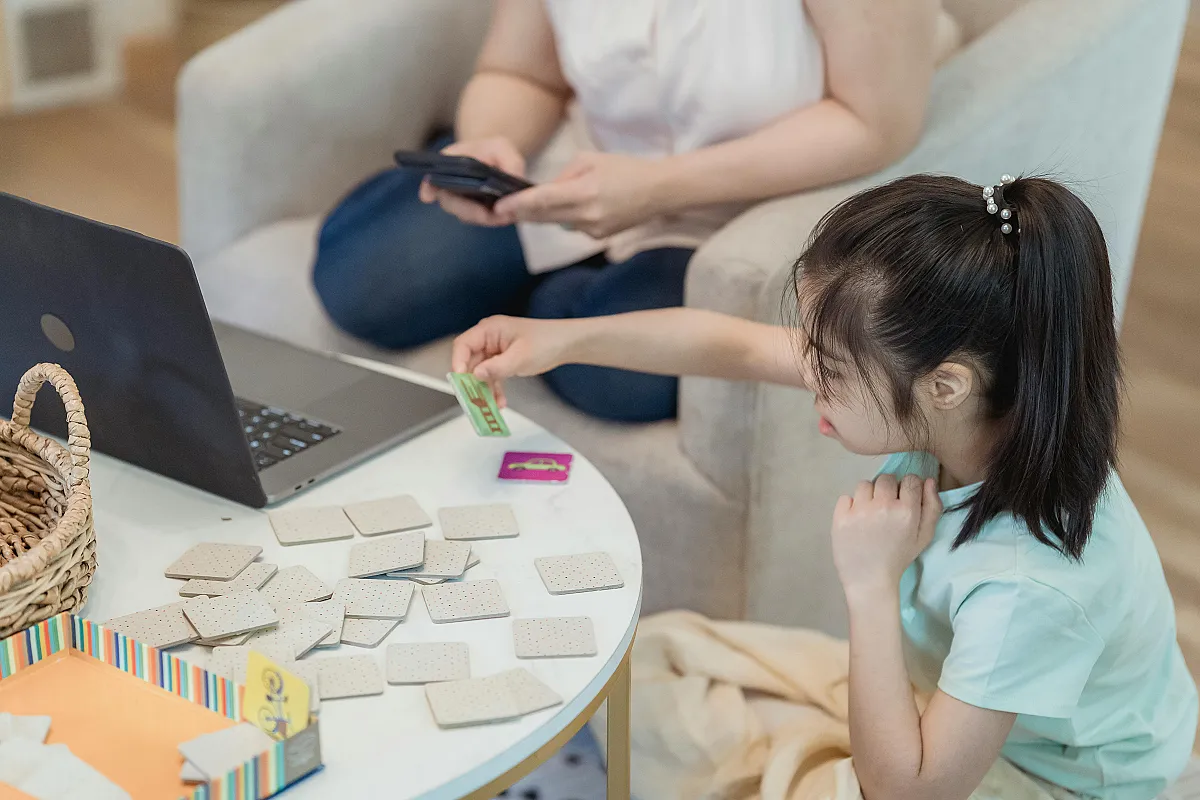
“My child is very inattentive, distracted, restless. He constantly forgets everything and makes mistakes.” This is one of the most common complaints from the mothers of our new students. When communicating with parents, misunderstanding, despair and powerlessness are strongly felt. We will understand what really happens to children, why persuasion and threats do not help them gather their thoughts, as well as how you can develop a child’s memory and attention through simple games.
Developing children’s memory and attention through play
Below are examples of games for children 3-6 years, which will help to develop visual and auditory attention of the child. The first type of attention is responsible for how well the child perceives information visually, and the second – by hearing.
Games for children that develop visual attention
1. What's missing?
You will need from 5 to 9 small toys or figures. It can be pencils, markers, lego parts, stones, toys from "Kinder" and so on. You need to name these objects aloud with the child, then let him look at them for half a minute, and then ask him to close his eyes. At this point, remove one of the items and ask the child what is missing. To complicate the task, you can remove several figures at once and ask what was missing and where it stood.
2. Find the difference.
This exercise will help the child develop not only memory, but also speech. For the game you will need two identical drawings, which on closer examination are different. Such pictures can be found on the Internet, and you can buy in the bookstore.
The child’s task is to find differences in the drawings and speak them out loud. During the game, attention, speech and orientation in space (right-left, top-bottom) develops. We recommend selecting the complexity of the drawings according to the age of the child.
3. Describe the subject.
This exciting game can be played right at home and start by describing the items in your child’s room. For example, asking him to carefully examine and describe in detail a toy, pet, or piece of furniture. The more small details a child can name, the better. You can help him by asking leading questions, as well as arrange competitions, who will name more details.
Developing Audiual Attention and Memory
1. Guess the sound.
Different objects are suitable for the game, with which you can make sounds: packages, foil, musical instruments, spoons, metal dishes. First, let the child listen to the sound of these objects, and then ask him to turn away and guess by ear what object in the hands of the second player makes a sound. Then the players switch places, and the winner is the one who made the least mistakes.
2. Music hide-and-seek
This game is simple, but very fun. You will need a bell and a safe space where there is nowhere to crash. According to the rules, one player is blindfolded, and the other has a bell in his hands. A blindfolded child must guess from the sound of the bell where the second player is. Then you can switch places and play until you get tired.
3. Name a mistake.
You will need any book with children's poems. An adult should read aloud poems that the child knows and deliberately make mistakes in words. The child’s task is to hear, name and correct these mistakes.
How else to develop the child's attention
We have considered educational games for memory of attention to children, and now we will tell you what other methods for this.
Reading and retelling
This method is suitable for the development of memory and attention of the child from an early age. It’s simple – read more to your child out loud and ask him to retell what he heard. And if he already knows how to read, just act as a listener. Reading and retelling immediately engages and develops visual, auditory, tactile and motor memory in children.
We count.
Very effective educational games for memory and attention of children - on the verbal account. Different counters strain the child’s memory and create associations, which contributes to the development of thinking and improving academic performance in the exact sciences. You can study with preschoolers and schoolchildren, and start with memorizing numbers.
Learning languages
Knowledge of two or more languages contributes to the development of memory, attention and intellectual abilities. Focusing on the learning load of the child, you can add classes to learn one or two additional languages.
Take IQ tests.
There are many different tests for children: to test knowledge, to identify creative abilities, etc. But tests for the level of intelligence are more popular, but it is important to take into account the age and level of knowledge of the child.
Based on the results, you will be able to understand whether to devote more time to the development of the child, as well as receive recommendations on how to improve his abilities.
What else to pay attention to
Before you start developing classes and exercises, you need to take into account the physiological state of the child: what is his training load, whether the diet is well balanced, whether he has enough physical activity and walks in the fresh air.
Remember, any activity with a child should be approached creatively. Since for preschoolers and younger schoolchildren, play is the main activity. Through the game, they learn the world, get acquainted with emotions and feelings, structure information, learn. Try to adjust to your child, think about how to make classes as interesting and bright as possible, so that it was pleasant for both of you. And also observe regularity, because games for children, developing memory, bring results only with constant training.

Leave a Comment