

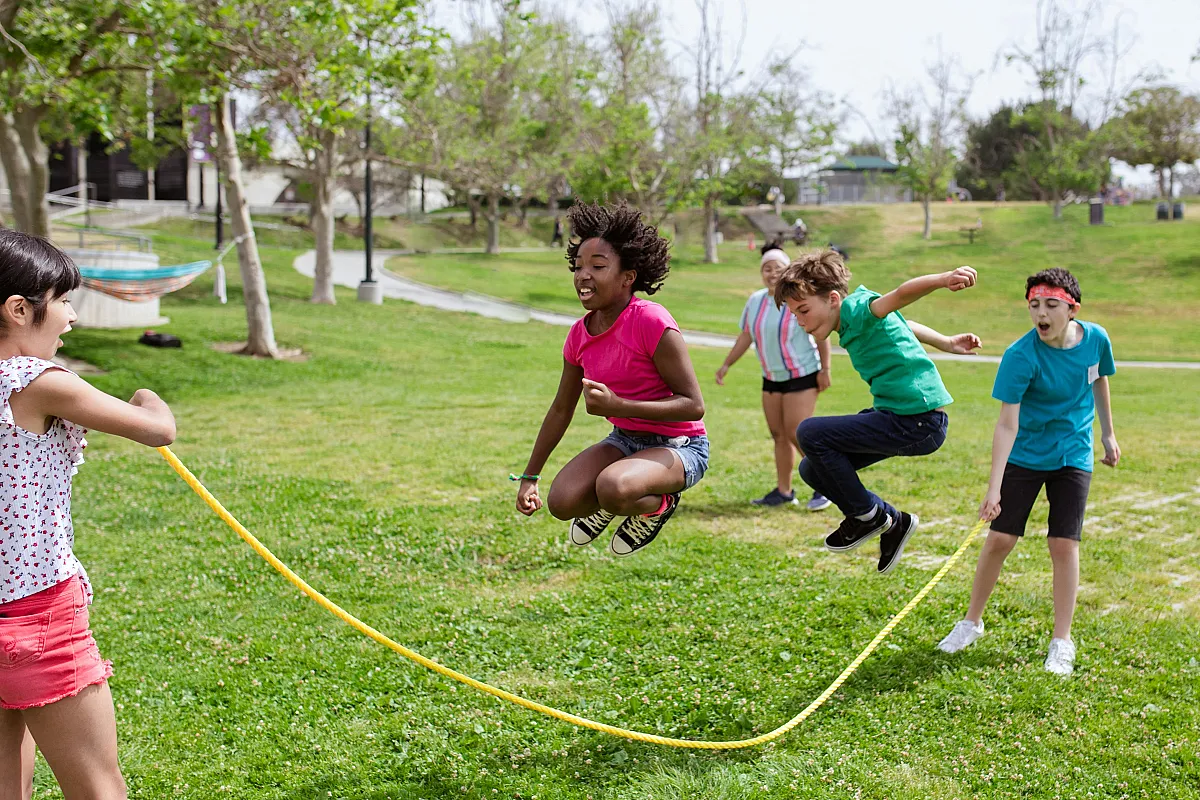
Today, most children share one common hobby—the screen. Cartoons, games, and social media take up hours that used to be spent running, jumping rope, and playing tag. A real epidemic of hypodynamia has emerged: children move less, get tired faster, and more often complain of poor vision and back pain.
But parents and teachers don’t need to become entertainers and figure out how to occupy a child without a gadget. It’s enough to have a set of simple active games for children that can be played in a group or in pairs, indoors or outdoors. This article features just such games.
The games don’t require complex equipment, are easy to explain in one or two minutes, and help wake up a child’s body and mind.
In this article, you will learn:
— which active games for children aged 6–10 are especially beneficial;
— which active games for children can be played both outdoors and at home;
— how to organize a game so that children are engaged rather than in conflict;
— how to incorporate active games into a family’s or class’s daily routine.
How Active Games Help Children’s Health and Development
Facts About Hypodynamia in Children
Modern schoolchildren spend less than 1–1.5 hours a day in motion, with the rest of the time spent sitting—at a desk or in front of a screen. This affects not only their health but also their behavior.
What lack of movement leads to:
— fatigue and reduced attention;
— posture and muscle tone disorders;
— anxiety and irritability;
— difficulty falling asleep;
— excess weight and low endurance.
At the same time, 30–40 minutes of active play per day significantly improves a child’s well-being and mood.
Why Active Games and Not Just Sports
Sports involve discipline, training, and competition. Active games for children are simpler and more accessible. They suit children with different levels of physical fitness, don’t require equipment, uniforms, or special gear. Plus, children don’t see games as another obligation, even though they are beneficial and help develop coordination, reaction time, attention, negotiation skills, and much more.
Important: We’re talking about games for children aged 5–6 and older. This is the age when a child already understands rules, can wait their turn, and play as part of a team.
10 Active Games for Children: Rules and Variations
“Tails”
An active game for reaction and speed.
Age: from six years old.
Location: open indoor space or outdoors.
Number of players: from four people.
How to play:
1. Each player attaches a “tail” to their belt or back pocket—a ribbon, scarf, rope, or strip of fabric.
2. At the leader’s signal, everyone moves around the area and tries to pull off others’ tails while protecting their own.
3. A player who loses their tail is out.
4. The winner is the one who keeps their tail the longest or collects the most tails.
What it develops:
— reaction speed;
— coordination;
— spatial orientation.
Variation for active games for children aged 7–10 and older:
— add zones where players cannot go—for example, let the center of the room become a swamp;
— add new rules each round—for example, tails can only be pulled with one hand, while the other must be behind the back.
“Freeze-Dance”
A game for self-control, balance, and rhythm. It works well as a warm-up before activities, including school.
Age: from five years old.
Location: can be played anywhere.
Number of players: from two people.
Rules:
1. Music is played, and children dance, jump, and move freely.
2. As soon as the leader stops the music and says “Freeze!”, everyone must freeze in the pose they were in when the signal sounded.
3. Anyone who moves, doesn’t hold the pose, or falls must complete a small task: jumps, squats, etc.
4. The game continues for several rounds.
Benefits:
— warms up the body well;
— improves balance and endurance.
How to make it harder for older children:
— introduce different commands—“Freeze like a robot!”, “Freeze like a monkey!”, “Freeze like a soccer player”;
— change the speed of the music and the nature of the movements (fast/slow).
“Hunters and Foxes”
A team running game for reaction, endurance, speed, and attentiveness.
Age: from six years old.
Location: ideal for outdoor active play.
Number of players: from four people.
Rules:
1. Children are divided into two teams: “foxes” and “hunters”.
2. Boundaries are marked within which the game can be played, as well as a “den” for the foxes.
3. At the leader’s signal, the hunters begin “catching” the foxes by touching them with their hand.
4. A caught fox either becomes a hunter or goes to the “den” until the next round—decide in advance.
5. The game ends when all the foxes are caught.
Important:
— before the game, explain the rule of no pushing and “catching” only by hand touch;
— monitor safety, especially outdoors.
Benefits of the game:
— develops endurance and speed;
— teaches tactics and teamwork.
Advanced version:
— switch roles during rounds—foxes become hunters and vice versa.
“Color Teams”
A game for attention and reaction speed.
Age: from five years old.
Location: can be played anywhere.
Number of players: from six people.
Preparation:
1. Each child chooses a color for themselves (or the leader hands out color cards/ribbons).2. The leader names colors in different orders and gives tasks. For example:
— «Only greens — hop on one foot!»
— «Only blues — run to the wall and back!»
— «Reds and yellows switch places!»
— «All colors squat!»
What it develops:
— auditory attention;
— reaction speed.
Advanced version for older children:
— for children 7–10 years old, add double tasks to the game («Yellows — jump, blues — crawl»);
— add forbidden words, upon hearing which, children must freeze, squat, or run away and hide (Word — «left», «Yellows, raise your left hand!» — children run away).
«Spy Mission»
Active quest indoors or outdoors.
Age: from six years old.
Location: can be played anywhere.
Number of players: from two people.
Game idea: children complete a chain of secret tasks that require movement, coordination, and attention.
Task examples:
— crawl under «lasers» (stretched ribbons or ropes);
— run to the chair while the timer is running, take the «secret letter»;
— walk along the «rope» (line on the floor).
How to organize:
1. Come up with several tasks, arrange them along the route.
2. For each point — a short note with instructions.
3. You can create individual missions or divide children into teams.
4. At the end, be sure to give a small prize: stickers, medals, treats.
Children will definitely get a good workout, but what exactly will be trained during the game — balance, attentiveness, flexibility — depends on your tasks.
«River Crossing»
Game for coordination and teamwork. Can be part of a sports event or class hour.
Age: from six years old.
Location: open space, long corridor, street.
Number of players: from two people.
Preparation:
1. On the floor, mark the «river» — with a line, ribbons. If playing in a room, the river can be the entire room; if outdoors, the sidewalk or entire area.
2. Also place «stones» on the floor — pillows, cardboard sheets, mats.
Rules:
1. The team's task is to cross the river using only the stones.
2. Stepping on the floor, «into the water», is not allowed; otherwise, the team starts over or loses one stone.
3. Children must agree on how to move, who goes first, who will pass the stones further.
What the game teaches:
— team interaction;
— planning steps;
— carefulness and coordination.
Advanced variations:
— limit the time;
— make the crossing «there and back»;
— some children participate with their eyes closed, such players are guided by voice.
«Mirror»
Game for movement awareness. Suitable as a gentle warm-up at the beginning or end of the day.
Age: from five years old.
Location: can be played anywhere.
Number of players: from two people.
How to play:
1. Children stand in pairs facing each other.
2. One is the «person», the other is their «mirror».
3. The «person» moves slowly, and the «mirror» tries to accurately repeat all movements simultaneously: bends, turns, gestures.
4. At any moment, the leader can switch their roles.
Benefits:
— develops observance and attention;
— helps children feel their body better.
Variations:
— play to calm or, conversely, fast music;
— add facial expressions — show a smile, surprise, sadness, laughter.
«Edible — Non-Edible 2.0»
Age: from five years old.
Location: open space, street.
Number of players: from two people.
The classic version of this game is familiar to many, but we will make it more active.
Rules:
1. The leader stands opposite the children with a ball.
2. They throw the ball to a child and simultaneously say a word.
3. If the word is «edible» — the child catches the ball in a jump.
4. If «non-edible» — they hit the ball or jump aside.
5. If the child catches a non-edible, they perform a task. For example, jumps, squats, etc.
How the game helps:
— trains reaction, auditory attention, and coordination;
— develops auditory attention;
— improves coordination.
«Engineer»
Game for coordination and group cohesion.
Age: from six years old.
Location: open space, street.
Number of players: from six people.
How to play:
1. Children stand in a circle or line, place their hands on each other's shoulders or hold waists — forming a «train».
2. The leader or the first child is the «engineer». They set the movements. For example:
— steps forward/backward;
— turns;
— light squats;
— «wave» with arms, torso.
3. The others must synchronously repeat the movements without breaking the «train».
Benefits of the game:
— develops sense of rhythm, coordination, ability to move together;
— creates a sense of unity, which is especially important for a class group.
Advanced version:
— the «train» must both perform tasks and pass between obstacles;
— the «engineer» changes every five tasks.
«Treasure Hunt»
Active search game with tasks.
Age: from six years old.
Location: home, yard, park, school.
Number of players: two or more.
Idea: children search for treasure while completing physical tasks.
How to play:
1. Prepare a "map" or list of clues. For example (if playing in a playground):
— "Climb the slides, at the top of one of them is the first clue hidden";
— "Run around the fence—somewhere there is the next note".
2. At each point, children find a new physical task and a clue to the next location.
3. In the finale—"treasure": a small box with prizes, stickers, a congratulatory note.
An excellent option for an outdoor active game for children:
— you can use the terrain—hills, trees, paths;
— children get natural exercise while being engaged in an interesting mission.
How to adapt active games for children of different ages
Children under six years old
For older preschoolers, it is important:
— simple, short rules (two or three conditions at a time);
— the leader actively participates, demonstrates movements;
— rounds are short, games change.
Children 7–10 years old
Active games for children 7–10 years old can be made more intense:
— add competitive elements (points, team scores);
— complicate tasks (time limits, obstacles);
— involve the children themselves in coming up with rules and variations.
Outdoor active games for children: why they are especially beneficial
Why you should move games outdoors as often as possible:
— more space for running, jumping, and other movements;
— natural endurance training (uneven surfaces, wind, different temperatures);
— reducing stress and tension after school;
— strengthening immunity.
The best outdoor active games for children from our list:
— "Hunters and Foxes";
— "Tails";
— "Treasure Hunt";
— "Spy Mission";
— "River Crossing".
Outdoor safety tips:
— check the area in advance for pits, glass, slippery spots;
— discuss boundaries with children that they should not cross;
— go over basic rules—no pushing, no grabbing clothes, tie shoelaces;
— do not play near dangerous objects—construction sites, roads, garages, etc.
How to bring movement back into life through games: a few simple steps
Step one: situation analysis
1. Assess how much the child actually moves during the day. Take into account:
— the way to school and back;
— physical education classes;
— walks, extracurricular activities.
3. Discuss with the child what interests them: what active games they like, whether they enjoy competitions, quests, or dancing.
Step two: preparation
1. Make a mini-list of active games for children that suit you:
— two games for home (e.g., "Freeze-Dance", "Mirror");
— two or three games for outdoors ("Hunters and Foxes", "Tails", "Treasure Hunt");
— one or two games for school breaks ("Edible—Non-Edible 2.0", "Color Teams").
2. Get minimal equipment. Most likely, everything listed is already in your home or can be replaced with household items:
— a light ball, or any soft toy as a substitute;
— several ribbons, or scarves, ropes ("these are the very tails");
— paper circles or sheets, pillows (puddles, stones);
— stickers or small prizes for quests.
3. Think about places for games:
— in an apartment or classroom—where chairs can be moved, fragile items removed;
— outdoors—a safe playground, yard, park.
Step three: making movement a habit
- Introduce a rule: "Every day—at least 30 minutes of active play". For example, at home, these can be games before school instead of exercise, after school—playing with classmates in the yard. "Freeze-Dance"
- For a school class, you can organize "movement breaks" for five to ten minutes.
- Make movement a natural part of the day, not a mandatory workout. It is important to maintain a playful format, let children choose the game, and offer them to be leaders.
- Once a week, arrange a family or class game day: choose three or four games and play them in a row. This creates a positive tradition and strengthens the motivation to move.
Frequently asked questions about active games for children:
How much time should children spend playing active games every day?
The World Health Organization recommends at least 60 minutes of moderate to vigorous activity per day for children from five years old. It is not necessary to do sports: active games perfectly cover part of the physical activity norm. 30 minutes in game format every day already noticeably improve attention, mood, and the child's physical condition.
What to do if the child does not like running and being active?
Start with games that have less competition and more creative elements: "Mirror", "Freeze-Dance", "Spy Mission". Let the child choose tasks, music, and roles. Often, resistance is not related to movement but to the fear of not coping, losing, or overexerting.
Can you play active games at home if there is little space?
Yes. Quiet or compact options will work: "Freeze Dance," "Mirror," and even the "Spy Mission" quest. Before playing, simply remove fragile items and ensure free space.
What active games are best for children aged 7–10?
Schoolchildren enjoy games with elements of tactics, competition, or missions. "Hunters and Foxes," "River Crossing," "Treasure Hunt," and "Spy Mission" — these games provide enough challenge and engage even children who prefer gadgets.
How to avoid conflicts and hurt feelings during games?
First, clearly explain the rules in advance and keep it brief. Second, collaborate with the children: switch roles and leaders, praise participation, not just winning.
The clearer the rules, the fewer disputes.
Can active games be used in school?
Not just possible — necessary. They are great for short physical breaks during lessons, active recess, class hours, and waiting times (e.g., before lunch or a walk). Games help burn off energy and improve focus in class.
What if children get too overstimulated during active games?
Use the "calm finish rule": after an active game, play a quiet one. For example, a breathing or stretching game. This helps the body and nervous system transition.
Conclusion
Active games are not just a way to burn off energy but a natural and joyful path to health, development, and emotional well-being for a child. Through movement, children learn to feel their bodies, interact with others, manage emotions, and confidently try new things. Regular activity in a playful form helps strengthen health, develop attention and imagination, and most importantly — makes movement a part of daily life, not a chore.
Even small changes can make a noticeable difference: one game in the yard, a few minutes of active break at home, or adapting familiar games to the child's age and abilities. You don’t need to wait for perfect conditions — you can start today using the ideas and steps from this article.
If the article was helpful, share it with those who care about bringing movement and the joy of play back into children's lives.


Leave a Comment