

Many articles have been written on the development of fine motor skills in children and a large number of videos have been shot. But if you are concerned about the development of speech and the skill of beautiful writing in your child, we recommend that you take 5 minutes and read the material that we have prepared.
What are fine motor skills?
In simple words, fine motor skills are movements using hands and fingers. From the point of view of the scientific definition of the toes, this also applies.
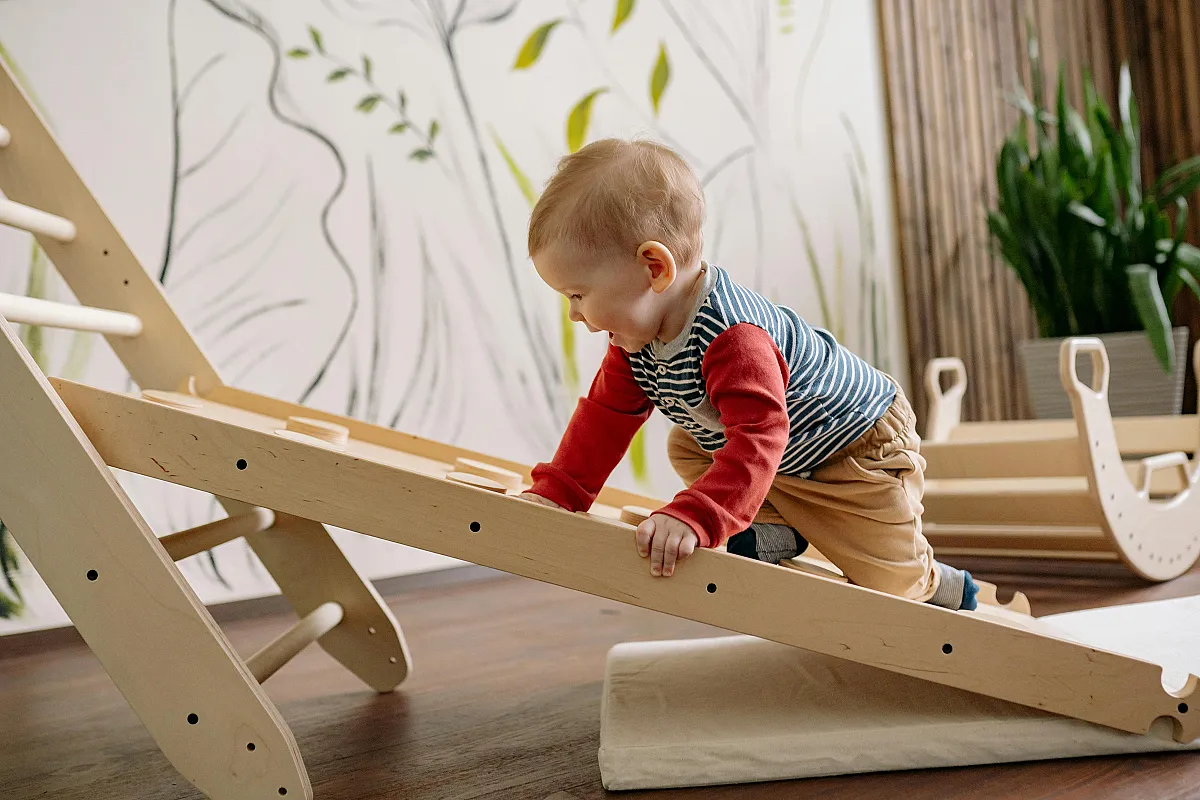
The development of fine motor skills in children can be traced at an early age, when the baby is just trying to take a toy with his fingers. First, the hands develop, then the movements of the fingers become more clear - all these are prerequisites for the formation of speech.
It is necessary to develop fine motor skills in a child so that the movements of the hands are clearer, since the formation and development of speech centers in the brain directly depends on this. The motor and speech centers are close to each other. In addition to speech, fine motor skills contribute to the development of memory, thinking, imagination and orientation in space.
Features of development
Well-developed fine motor skills are not inherited. Parents and teachers play a huge role here, working with the baby from early childhood.
Why is this issue getting so much attention? Because fine motor skills are the basis for the development of all skills and abilities:
- development of speech at an early age;
- skills of hand movements: play, drawing, modeling, construction;
- the ability to self-service: eat, dress, wash;
- preparation for schooling.
At what age to start developing small motor skills
From the first days of life, neurologists recommend that mothers do gymnastics with the baby: move their hands, legs, put their finger in his palm, perform various stroking, turn over, etc. All of these exercises stimulate the development of the cerebral cortex until the baby learns basic movements on its own.
Up to eight months, children strengthen muscles, develop coordination, so full-fledged exercises and games for the development of fine motor skills of the hands should start about a year. Then the baby already knows how to sit, is actively interested in the world around him, crawls, picks up toys. During this period, you can start trying through small objects (necessarily under supervision), play with sand, practice finger games.
To summarize: at what age to start active development of motor skills? There's no definitive answer. Each child has its own maturation rhythm, so there is no exact age limit.
The older the baby gets, the more important the role of exercises and games for the development of small hand movements.
Methods of development of fine motor skills in children
With children, you can start with the simplest activities:
Finger gymnastics
It is needed to relieve muscle tone and to stimulate the development of brain centers. To finger gymnastics include "This finger ..." and others who are familiar with our childhood.
Self-massage with barbed balls and Su-Jok balls
In Eastern medicine, exposure to acupuncture centers is good for health and helps brain development. Children also love these toys. And so that the ball does not get tired quickly, you can come up with different games. For example, to throw it to each other, roll it over to speed, etc.
Going through small objects
On the network you can find a lot of videos of how moms paint cereals in different colors, then mix them and let the kids play with them. For such games, various small items that you have at home are suitable. It is important not to leave the child unattended so that he does not swallow anything.
Bi-board games
This is a board where all sorts of interesting things for a child are collected in one place: shoelaces, spingallets, locks, bells, gears and so on. Children love to play with all these objects, while developing fine motor skills.
With children from three years old, you can engage in modeling, drawing, construction and other types of creativity.
Games and exercises
For children 2 to 3 years
Round and paint.
Based on age, you can offer the child a coloring book, where you first need to circle the picture along dotted lines, and then paint.
Puzzles.
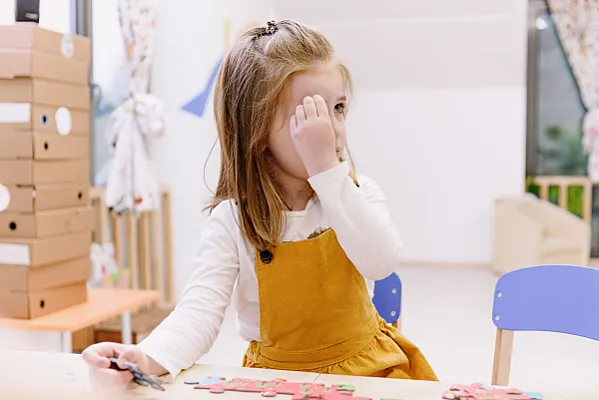
Puzzle games help the child develop figurative and logical thinking, attention. He learns to perceive and distinguish individual elements by shape, size, colors, and fine motor skills are trained in the process. Choose puzzles, focusing on the age of the child. For children three years old, you need to choose simple pictures with large details.
Painting in the sand
You can buy a special board with sand, or you can make a simpler option by taking a regular tray and river / sea sand. Preliminary sieve it through a sieve to remove sharp objects, shrapnel from shells and pour on a tray with high edges. First, show your child how to draw with your finger. And then ask him to draw simple figures: circle, triangle, square.
For children 4 - 5 years
Lapkin.
For this lesson, you can take dough, clay or plasticine. Let the child independently warm up and stretch the material, and then starts sculpting with simple figures: balls and sausages. As you grow older, you can try to sculpt more complex products. Also, with the help of plasticine, you can make whole paintings on sheets of paper.
Cut and glue.
First, let the child learn to cut from ordinary white sheets, then from colored paper, and then from cardboard. The task is to show the baby how to properly position the scissors in the hands to carefully cut the figure without breaking the contour. With each time, you can complicate the task, moving from cutting ordinary circles to elements that will then need to be glued together to get a craft.
For children 6 years old
Training materials are suitable to not only develop fine motor skills, prepare your hand for writing, but also develop a beautiful handwriting.
We know for sure that you can teach preschoolers and schoolchildren how to write beautifully in 4 simple steps:
- Work on fine motor skills with the help of special exercises developed by teachers.
- Learn to sit properly, so that the letter does not tire and give pleasure.
- Learn how to hold a pen properly.
- Regularly hone the skill of writing according to our author's instructions. 
The main thing is that all classes should be carried out in a playful form and observe regularity, then the result will not take long to wait.
Come on! Towards knowledge and adventure!


Leave a Comment