

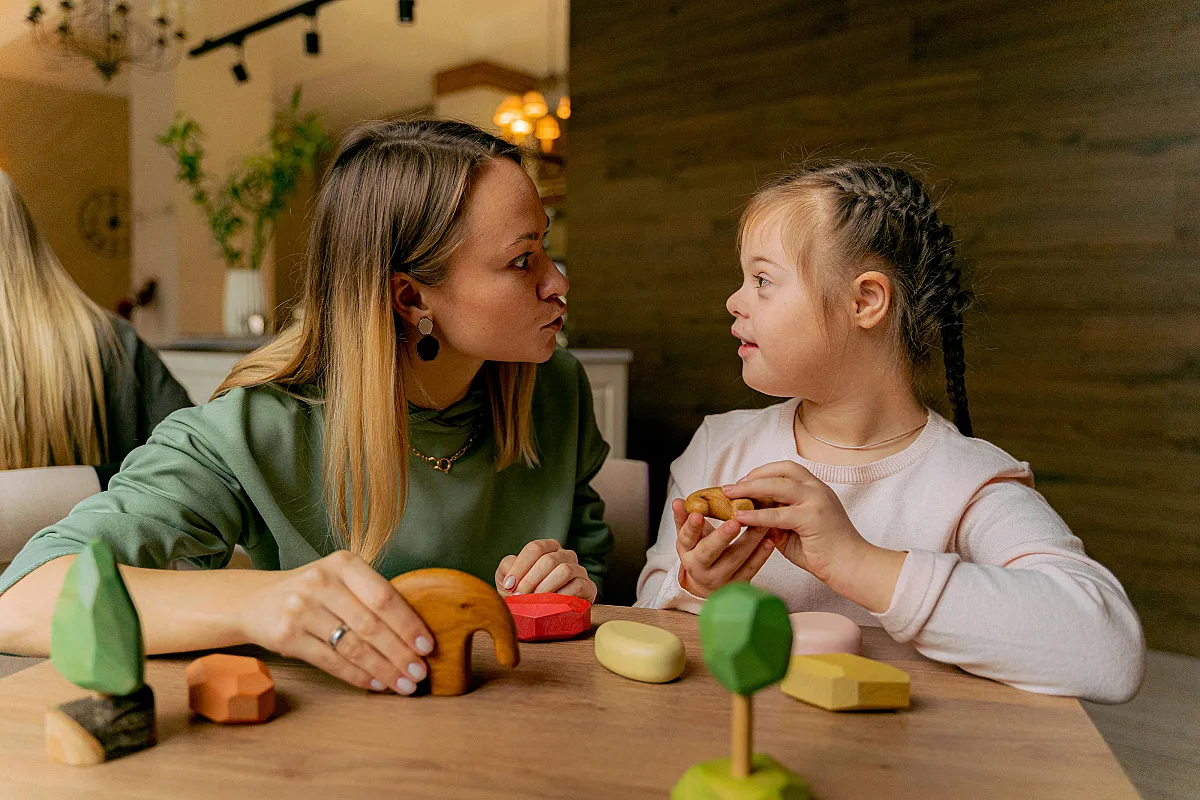
When and how to start developing speech in preschool children? In fact, a child learns to speak from birth, but each baby needs their own time before their first clear words and sentences. There is no specific period when you need to pay more attention and effort to activities to make them speak faster. It's better to engage every day.
⠀
In this article, you will learn about recommendations and exercises that will help easily develop oral speech in a child at home.
Factors that influence children's speech development
Every person is born with individual characteristics that affect the formation of skills, qualities, character, etc. Speech therapists and psychologists identify 4 main parameters for speech development:
1. Features of the anatomical structure of the speech apparatus
In the maternity hospital, a pediatrician and neonatologist examine the baby to timely identify and correct congenital anomalies, if any. Closer to 4 years of age, the doctor decides on the need for surgical correction if it is impossible to correct the disorders with special exercises.
2. Physiology
Here, we want to talk about fine motor skills of the hands and their connection with the development of the brain and speech. Molding, drawing, and handling small objects will help your child speak quickly and clearly.
3. Interaction with family
The more relatives a little person communicates with from early childhood, the faster their sound speech development occurs. The main thing is not to use baby talk; call objects by their names so that the child gets used to correct pronunciation.
4. Emotional factor
It is important for a child to feel a strong emotional connection with their parents. Therefore, respond to everything the baby does: if they reach out, reach back; if they smile, smile back, etc.
This creates a favorable psychological climate in the family and ensures normal development in all areas.
Of course, there are various disorders that are not always noticeable immediately. Problems may appear by the age of 3. If by this age something concerns you about the development of coherent speech in your child, read the article: Child does not speak at 3 years old: when to worry and what to do?
There is also a table with speech development norms by age.
How to develop proper speech in a child at home
We won't give complicated recommendations. Our exercises are simple, understandable, and fun games. The activities include stages:
- hearing training;
- development of fine motor skills;
- speech exhalation exercises;
- articulation exercises;
- vocabulary expansion.
Let's explore each point.
Training hearing
We mention phonemic hearing in almost every article. It is what determines how a child will hear, distinguish, and pronounce sounds. Here are a couple of examples of games for training auditory attention:
"What do you hear in the silence?"
You and your child just need to be silent for a while, then describe the sounds that broke the silence. For example: a cat walked by, a car engine rumbled outside, etc.
"Who hears more"
Here you can arrange a competition, wherever you are. Set a minute and count how many different sounds you heard. Whoever hears more wins.
Other exercises for developing phonemic hearing in children aged 3–6 can be found here.
Developing fine motor skills
In the brain, speech and motor centers are located close to each other. Therefore, any activity that stimulates fine motor skills has a good effect on speech development.
Among the first games for training a child's hands, cereals, buttons, and finger paints are ideal. If the baby has a habit of putting everything in their mouth, stay close to them so they don't swallow anything.⠀
For older children, games with a constructor, drawing, coloring, weaving, molding, and crafts from colored paper are suitable.
Training speech exhalation and doing articulation exercises
Ideally, by 4–5 years old, a child should already pronounce all sounds. To achieve this, it is necessary to prepare the articulation apparatus for clear pronunciation in advance. Here are some speech development activities for children that will help you with this.
"Cotton football"
Roll a ball out of cotton and place two small boxes at a short distance. These will be the goals. Tell the child to blow on the ball and score goals.
"Motor"
For this exercise, you need a spinning top toy that can be "brought to life" by blowing hard.
"Butterflies"
This game is suitable even for the youngest. You need to cut out butterflies from paper, attach strings to them, and hang them. The task is to blow gently so that the butterflies fly.
"Duck-tube"
The child needs to hold their lips in a tube shape for as long as possible, with their jaw closed.
"Fence"
Ask the child to smile and clench their teeth tightly. They need to hold this position for as long as possible. This exercise improves the work of several facial muscles: circular, buccal, zygomatic, and angular.
"Tongue cleans cheeks or self-massage"
Let the child use their tongue to massage their cheeks from the inside. This exercise also trains the muscles and improves blood circulation in the oral cavity.
Expanding vocabulary
The more words a child knows, the richer and more coherent their speech will be. Learning new words every day is also easy and simple through play. The most effective methods for expanding vocabulary can be found in the article: 5 ways to learn words quickly!
⠀
Also, don't forget to read aloud to your child more often. From books, they will learn many new words, learn to construct sentences correctly, and express their thoughts.
Be attentive and avoid mistakes
Why is it so important to develop a child's speech from early childhood and correct disorders in time? Because in the future, defects can lead to problems with learning to read and write.
If you feel that your child needs help but you can't handle it yourself, it's better to consult specialists (defectologist, teacher, speech therapist, child psychologist).
The main thing is to support your son or daughter in all their endeavors and aspirations, praise them even for small successes. It is encouragement, admiration, and the absence of negative evaluations from an adult that are the secret to successful learning, which works with children of all ages. Proven!
In such an atmosphere, a child simultaneously learns to pronounce all sounds, read, and write easily. They also develop leadership qualities from an early age. That's how mutual love works! And if you decide to entrust your child's speech development to a specialist, be more attentive.


Leave a Comment