

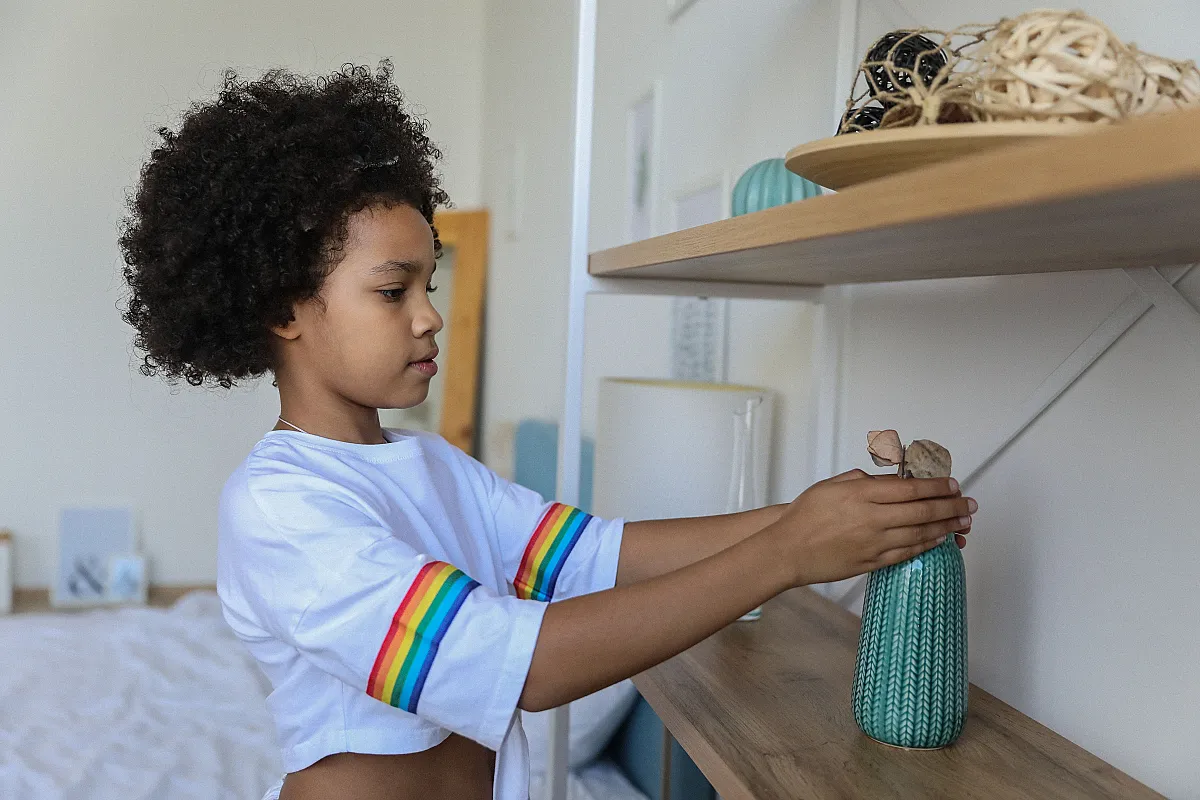
How can you teach a child to be tidy? By setting a personal example. In a sports-oriented family, children grow up to be agile and resilient; parents who read books can spark a child’s interest in the mysteries of the literary world. Disciplined and tidy people live in clean and orderly environments. For younger children, cleaning in a playful way is a good option, while for older children, sharing household chores equally with parents is ideal.
What should you pay attention to? A love for tidy and the habit of doing chores depend on the child’s upbringing and personality. For neat, calm children, cleaning will be a joy; for creative types, mess is a backdrop for creativity and imagination. Therefore, you need to take the child’s individuality into account when instilling a habit of tidy and cleanliness.
Why a child doesn’t keep things tidy
Children don’t always see the point in tidying up. For them, making the bed or putting away toys isn’t a necessary task, but something trivial. To understand how to teach a child to be tidy, it’s important to figure out where this indifference to cleanliness comes from.
- Lack of motivation. Even adults often view tidying up as a chore. However, parents maintain cleanliness because they value comfort. For a child, though, a mess might be the norm. If they don’t trip over scattered items, then there’s no problem.
- The goal is unclear. Some children see clutter as creative chaos, where everything they need is within reach. Others simply don’t care what their room looks like, since aesthetics don’t matter to them.
- An undeveloped skill. When parents take on all household chores, the child gets used to the idea that cleaning isn’t their responsibility. It takes time to develop the habit of automatically performing household duties, just as it does with personal hygiene routines.
- Exhaustion. Children, like adults, get tired: from school, homework, clubs, and extracurricular activities. When energy is running low, cleaning takes a back seat.
- Forgetfulness. Often, it’s not a matter of unwillingness, but simply that the child forgets. If their planning skills aren’t developed, they may get distracted and overlook small household tasks.
Why it’s important to teach a child to be tidy
Many modern parents strive to give their children a carefree and vibrant childhood, trying to shield them from household chores. That is precisely why the responsibility for tidying up, including cleaning the child’s room, is most often taken on by adults. However, this approach prevents the child from developing self-organization and responsibility skills.
Parents often miss the window when a child can view household chores not as a boring duty, but as an interesting and useful activity.
If, during this period, adults can gently involve the child in household routines, the child will begin to feel a sense of self-worth and confidence in their abilities. This is the answer to the question of how to teach a child to be clean and organized—through participation and involvement, not coercion.
As the child masters simple household tasks, they will begin to understand that cleanliness and tidy do not happen on their own but are the result of specific actions. This skill is a crucial element of growing up, shaping the ability to care for oneself and one’s space.
Early involvement in household chores helps a child develop a healthy attitude toward work. Gradually, they begin to realize that their contribution matters, and that participating in family life is a natural and valuable part of daily life.
This is especially relevant when it comes time to teach an 8-year-old to keep their room tidy, as their curiosity about the world around them combines with a desire to be “like grown-ups.”
The ability to see things through to the end is useful in any profession, even the most creative ones, because every job involves routine tasks. And those who have learned from childhood to persevere through the boring parts are more likely to succeed.
8 Misguided Strategies That Undermine a Child’s Desire for tidy
A child’s desire for tidy can easily be undermined by incorrect parenting approaches. What common strategies, despite good intentions, hinder the development of healthy habits for organizing space?
Inconsistency in personal example
If adults themselves leave dirty dishes on the table or leave things scattered around, it’s pointless to demand different behavior from a child. Children copy their parents’ habits rather than following their instructions. Want to understand how to teach a child to keep the house tidy and clean? Start with yourself.
Overprotection
By constantly cleaning up after your child, you deprive them of the opportunity to learn independence. Even toddlers aged three or four are capable of putting toys in a box or wiping up spilled juice. It’s just important to show them how to do it correctly.
Turning Cleaning into a Punishment
Phrases like “Since you misbehaved, you’ll have to mop the floor!” foster a negative attitude toward cleanliness. It’s better to present household chores as a sign of maturity: “You’re big enough now to make your own bed!”
Excessive demands
Criticizing a child for carelessly hanging up clothes or not washing a plate well enough discourages any desire to try.
It’s especially important to keep this in mind when thinking about how to teach a 10-year-old to keep their room tidy—after all, this is the age when a personal attitude toward work is formed.
Doing the work for the child
If they haven’t finished cleaning up, don’t do it for them. Otherwise, they’ll learn that it’s okay to leave tasks unfinished—someone else will fix it or finish it anyway.
Comparing them to others
Phrases like “Look how neat your brother is” trigger internal resistance and undermine a child’s confidence. Instead of comparing them to others, encourage their personal achievements. If you want to understand how to teach a 12-year-old to keep their room tidy, don’t pressure them—give them space to take the initiative.
Excessive workload
A five-year-old can’t handle a deep clean, and a teenager might forget some chores because of their school workload. Assign responsibilities based on age and ability.
Material incentives as motivation
If doing chores is always tied to promised gifts, the child begins to see cleaning as a profitable deal rather than a part of daily life.
At the same time, it’s important not to skimp on sincere praise. If your child has cleaned up and done so thoroughly, tell them from the heart: “I was so happy to come home and see a clean room.” This simple acknowledgment of their efforts is often more effective than any reward.
How to Teach a Child to Be Tidy: Tips from Psychologists
Experts in child psychology offer effective approaches to developing a habit of cleanliness. Here is what they say about how to teach a child to be tidy and clean.
It is much more effective to turn the process into a game: who can put away toys or tidy things up the fastest. This kind of interaction helps the child perceive tidying up as a pleasant and understandable activity, rather than an imposed duty.
It is important not to impose strict rules, but to give the child the opportunity to make decisions independently: where their belongings will go, how to arrange books, and in what tidy to place toys. According to Gippenreiter, this is precisely what develops a sense of control over their space and fosters a respect for work.
Support from parents, rather than criticism, helps reinforce this feeling: simply acknowledging a good decision sincerely is enough to serve as strong motivation.
7 Practical Tips for Parents on Teaching Children to Be Organized
For a child to begin consciously maintaining tidy around them, it’s important not just to demand it, but to structure your approach effectively. Let’s look at a few effective steps that will help in this process.
Explain the purpose of what’s happening
Before asking your child to tidy up, explain why it’s necessary. If they understand that a clean room isn’t just a whim of the parents but a way to live comfortably, their resistance will decrease.
Your arguments should be clear and logical. Use the same approach you use when explaining the importance of school grades or sticking to a sleep schedule.
Lead by example
Calls for tidiness won’t work if adults don’t follow basic rules themselves. By keeping the house clean and showing how you tidy up without getting annoyed, you set an example worth following.
Help organize the space
For example, suggest ideas for organizing storage. Set up boxes, hang shelves, and sort items into containers.
The main thing is to make sure your child doesn’t have trouble figuring out where to put things. When everything has its place, it’s easier to keep things tidy.
Take it step by step
Don’t overload your child with a lot of responsibilities all at once. Start with simple tasks, such as putting clothes in a basket after a walk.
Establish a routine
To ensure your child doesn’t forget about cleaning, especially during the school year and when attending extracurricular activities, create a simple schedule. Make it a convenient routine. For example, on Fridays—wipe down the shelves; on Saturdays—sort the laundry basket.
Make the process fun
Background music makes any routine less boring. Play some upbeat tracks, and cleaning can turn into an active and positive activity, especially for younger schoolchildren.
Support and praise
Even if the result is far from perfect, it’s important to acknowledge the effort. Recognition and sincere praise boost internal motivation much more than nitpicking. It is positive feedback that helps form a lasting habit of tidiness.
Games to Teach Children to Be Tidy
Educators and psychologists agree: teaching a child to keep things clean is easier and more effective when play is involved.
“On the Trail of the Missing Toy”
One of the simplest ways to get a child interested is to organize a mini-quest. Parents discreetly hide one of the child’s favorite toys in the room. While the child is looking for it, they are asked to put the other items away.
“Tidying Up in 5 Minutes”
Set a timer for a short period of time, such as 5 or 7 minutes. The child’s task is to tidy up within that time. This format resembles a competition, sparks excitement, and makes even routine chores fun.
“Mom Reads—I Clean Up”
Some children thrive on joint activities that involve a “division of labor.” While the child tidies up, the parent reads an engaging book aloud.
“Where should we put this?”
Sorting is a great way to tidy up and organize things. Ask your child to sort items into categories: toy cars in one box, blocks in another, and stuffed animals in a third.
Themed stickers, cards, or helper badges can serve as good additional motivation. For each time they help with cleaning, the child receives a symbolic reward, which can be collected and exchanged for a desired bonus.
This approach helps develop consistent habits and fosters a positive attitude toward work.
Frequently Asked Questions About Teaching a Child to Be Tidy
It’s important not only to assign tasks but also to encourage. Even if the result is far from perfect, it’s better to praise them for their effort. And don’t forget to give your child a break, especially if they’re tired from school or other activities.
What household chores can a 6- or 7-year-old handle?
Preschoolers can already contribute to keeping the house tidy:
- vacuuming carpets;
- hanging up laundry after washing;
- help in the kitchen (clear the table and set it, rinse dishes);
- taking care of houseplants;
- take out the trash;
- heat up food in the microwave on your own;
- tidy up their room and desk.
You can also ask your child to walk the dog and clean up after it. At the cottage, you can have them rake fallen leaves, water the flower beds, or pull weeds.
What can a younger elementary school student do around the house?
Once they start school, children are capable of taking on more serious responsibilities. In addition to what they already know how to do, they can:
- cooking simple meals on their own;
- loading the dishwasher and washing dishes;
- wiping down surfaces;
- doing laundry and hanging it up;
- shopping and helping out at the supermarket;
- helping out at the summer cottage—from weeding to harvesting vegetables and berries.
How can you establish a good relationship with a teenager regarding household chores?
Adolescence is a time of change, accompanied by rebellion and the assertion of personal boundaries. Teens often refuse to do chores, openly disagree with their parents, and may deliberately break family rules.
During this period, it is important not to resort to pressure, shaming, manipulation, threats, or bargaining. Such methods are unhelpful; they only push the teenager away and destroy trust.
The best thing you can do is speak calmly, without reproach, and with understanding. Remember: this is a natural stage of growing up, when the parental figure temporarily takes a back seat.
In time, your child will grow older, and the warm relationship built on respect and acceptance will become a solid foundation for your bond for a lifetime.



Leave a Comment