

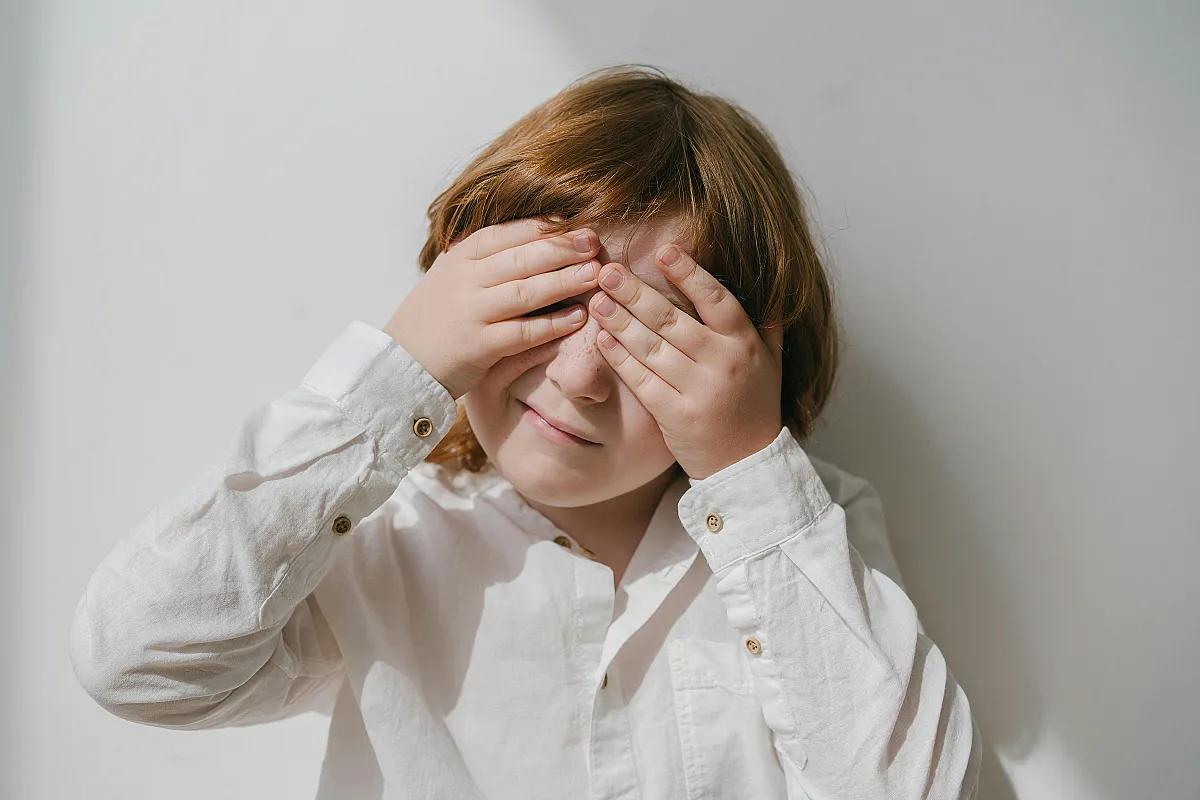
Is it true that shyness can be dangerous to a child’s psyche? Why are some children open and sociable, while others are shy and timid? How can parents help their child overcome shyness?
Shyness – the norm or deviation
Shyness is a kind of protection in incomprehensible situations. For example, when communicating with strangers, while we are red and confused, the brain evaluates how safe the environment is. The first signs of embarrassment can be seen for a child from five months, when a smiling baby suddenly begins to hide his face and turn away from strangers.
The next period, when children begin to be shy, comes about two and a half years. It is during this period that the nervous system is actively maturing and this is the norm.
However, as you grow older, shyness becomes more of a hindrance than a blessing. It prevents the child from learning normally, answering the board, making friends, expressing his opinion and generally achieving something in life. Everything in the world today is based on communication skills.
Why Your Child Becomes Shy
It is believed that shyness is inherited. But according to numerous psychological studies, everything is much simpler. A shy child is someone who has not been taught to communicate.
There are also a number of other factors that can affect excessive childhood timidity:
1. Features of education
For example, frequent prohibitions, punishments, offensive statements towards the child can cause the development of self-doubt and the emergence of excessive shyness.
2. Poor early development
When parents try to develop a child not by age. For example, to teach to read in 3 years, as a result of which the baby does not succeed, he faces criticism and closes himself.
Read on for early childhood development here.
3. Characteristics of temperament
It is believed that shy people are most among phlegmatics and melancholic. On the character traits of which additional factors affect the development of timidity are superimposed.
4. Hyperopecia
As well as excessive prohibitions, hyperprotection deprives the child of independence. Therefore, situations where he needs to prove himself cause him stress, the reaction to which manifests itself in the form of shyness.
5. Individual characteristics
Sometimes, a shy child becomes because of some features, if they are noticeable to others. For example, if you need to wear glasses, braces or orthopedic shoes, which can provoke ridicule from other guys. One careless word - and the child can be closed in.
Shyness of the child in preschool age
Let’s see how a shy child behaves. On the one hand, he treats others kindly, but on the other hand, he does not dare to make contact. There is also a conflict within the personality: on the one hand, he may consider himself the best and have a high general self-esteem, and on the other hand, he may doubt that others treat him the same way he treats himself. Therefore, shyness is most pronounced in communication.
Preschool age is the period when the child’s psyche develops most intensively. There is a formation and formation of character and important personality traits. As the preschooler grows up, and then the schoolboy, the usual style of behavior will only strengthen. The child will begin to realize his shyness and insecurity, which will more constrain him and prevent him from struggling with his difficulties and experiences.
Most often, shy children want to communicate, but either do not know how to approach a stranger and start a conversation, or, because of what internal experiences, are afraid to do it.
Therefore, the task of parents and teachers of preschool institutions is to help children overcome timidity and form a desire to communicate.
Shyness in school
Even sociable and confident children, getting into school, can become shy. It's all about the new environment. Many teachers prefer that children be seen but not heard in the classroom. Together with high demands, first-graders face a lot of criticism and lack of motivation. For most children, going to school is stressful.
Now imagine what it would feel like to have a kid in school who was timid and shy before first grade. His mild fear turns to anxiety because he thinks too much about the consequences of his school failures.
A healthy interest in learning is replaced by the pursuit of high grades, which prevents him from developing and enjoying his studies.
Therefore, it is very important for parents to always be on the side of their child and warn the school teacher that the child is calm and reasonable, but in no case “shy”, so that unnecessary labels are not hung on him in the walls of the educational institution.
Are there other approaches to teaching children and in which schools can they be found? Read our article on humane pedagogy.
How to help your child overcome shyness
Of course, first of all, parents need to observe themselves: is there not too many requirements for a child or, perhaps, too much care? Such questions will help to notice mistakes in education.
If there is, then it is worth starting with them, and then we will give an example of how to support a shy child.
1. Fewer surprises that can increase anxiety
Before going to a new place or meeting with strangers, you need to prepare your child in advance. Knowing where he is going, what he will have, the baby will feel calmer and more confident.
2. The right example
Let the child know how mom and dad behave in the company of other people and how to find a way out of certain situations. To do this, you need to build trusting relationships within the family and communicate more on topics related to communication and interpersonal relations.
3. Adequate self-esteem and positive perception
One of the main reasons for timidity is low self-esteem. It is necessary to praise the child for achievements and try to create situations from which he will emerge victorious.
Often shy children are afraid of negative opinions about themselves from others. To save a child from this fear, you need to form his confidence in his uniqueness. The faithful helpers of parents on the way to a positive self-concept of the child are support, love, lack of destructive criticism and comparison with other children.
4. Developed emotional intelligence
From childhood, you need to teach your child to understand the feelings of yourself and others. It is important not only to talk about emotions, but also to read books, watch cartoons, where the characters find themselves in various situations, living the whole spectrum of feelings.
You can also play scenes and give the child to visit different roles and find a way out in difficult situations. Because the development of personal qualities is no less important than the study of the exact sciences or languages. It is the foundation upon which man builds his adult life.
If you want to help your child overcome shyness, develop flexible skills so that he becomes more relaxed, friendly and courageous. He was able to negotiate and resolve conflicts peacefully, and he also learned to be more flexible in a changing world.

Leave a Comment